
How Extended Time Reduces Anxiety on High-Stakes Tests

Extended time reduces test anxiety by removing the immediate pressure of a ticking clock, which preserves working memory and cognitive control. For many anxious test-takers, that shift in emotional arousal is enough to let actual knowledge and strategy show through. Research from Elliott & Marquart and large-scale assessments like the NAEP confirms that perceived relaxation rises consistently with extra time, even when objective score gains may vary. If you have clinically significant test anxiety or a learning disability, extended time is one of the most evidence-supported accommodations available in U.S. high-stakes testing, including through LSAC.
Table of Contents
- What the research actually shows about extended time anxiety relief
- Which students are most likely to benefit from extra time
- How to use extended time so it actually reduces anxiety
- How to request extended time in U.S. high-stakes tests
- When extended time is not enough, and what to watch for
- Key Takeaways
- What clinicians see that most applicants miss
- Get your LSAT documentation prepared by licensed clinicians
- Useful sources
What the research actually shows about extended time anxiety relief
Research shows consistent reductions in perceived time pressure and anxiety for about 75–87% of students given extra time, with mixed effects on objective scores depending on test type and baseline anxiety level.
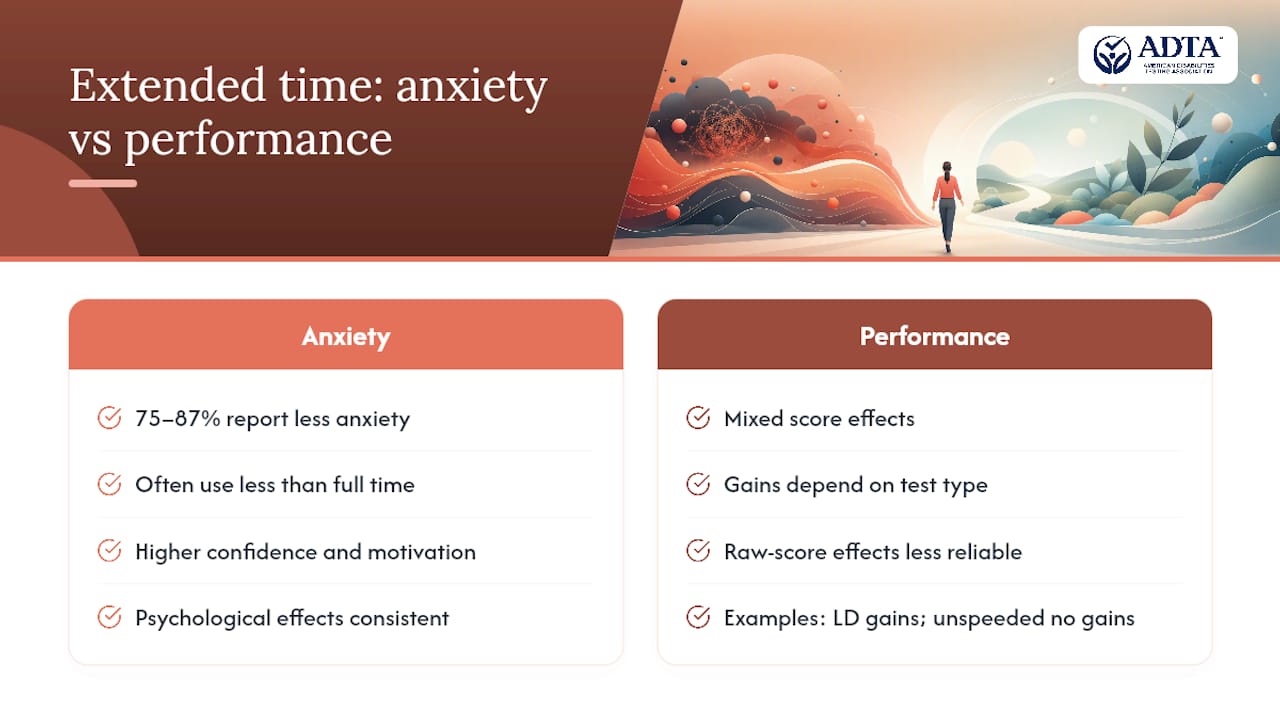
The Elliott & Marquart review found that across multiple studies, between 75% and 87% of students reported feeling more relaxed when given extended time. Many used less than the full allotment but still reported higher confidence and motivation. That psychological shift matters even when raw scores do not move dramatically.
On the performance side, a NAEP-based study found that students with learning disabilities who used extended time accommodation showed score gains on a digital math assessment, particularly when given substantial additional time. Students given that amount engaged more with time-consuming items and used digital tools more effectively than those without the accommodation.
The picture is not uniformly positive, though. A 2025 Frontiers study found that doubling time on an already-unspeeded undergraduate exam produced no improvement in performance or anxiety, though students with more time did report less desire for additional time. A WCER working paper reached a similar conclusion: extended time affects psychological functioning more reliably than raw scores, and results depend heavily on whether the test was already time-generous, the student’s disability profile, and how the extra time was actually used.
The takeaway is that extended time works best as an anxiety-reduction tool when the test is genuinely speeded and the student has a condition that time pressure specifically worsens.
Which students are most likely to benefit from extra time
Students with learning disabilities, severe test anxiety, or processing-speed impairments are the most likely beneficiaries. Students taking already-unspeeded exams may see smaller objective gains, but the affective benefits, feeling less panicked and more in control, often remain.
Indicators that extended time is likely to help you:
- Diagnosed learning disability (dyslexia, dyscalculia, processing-speed disorder)
- Clinically significant test anxiety confirmed by a licensed professional
- Visual impairment requiring accommodated formats (LSAC recognizes this as a distinct category)
- Processing-speed impairment documented in prior neuropsychological testing
- History of using extra time successfully in classroom or prior standardized-test settings
Who may see smaller benefits: students with low baseline anxiety, those taking tests that are already unspeeded by design, or students whose scores are limited by content knowledge gaps rather than anxiety or processing speed. Extended time removes an access barrier; it does not supply knowledge that was never there.
Pro Tip: Review your practice test confidence under timed versus untimed conditions. A notable gap between the two is one of the clearest signals that time pressure, not content mastery, is the limiting factor.
How to use extended time so it actually reduces anxiety
Use extra time proactively, with a plan, rather than simply letting the clock run longer while anxiety climbs.
Before test day:
- Practice at your approved accommodation level. If you receive 50% extra time, run every practice section at that pace, not standard time.
- Script exactly what you will do with the extra minutes: first pass for confident answers, second pass for flagged items, final minutes for review.
- Rehearse your in-test coping ritual until it is automatic. A grounding technique that takes 30 seconds is only useful if you do not have to think about whether to use it.
On test day:
- Set micro-deadlines per section so you are not drifting. Divide the total time by the number of questions and check your position at the halfway mark.
- Triage hard items early. Flag and move on rather than letting one question consume disproportionate time and trigger a spiral.
- Use permitted breaks as scheduled resets, not as emergency responses to panic.
- In the final minutes, resist the urge to second-guess answers you felt confident about on first pass.
Pairing these tactics with accommodations is exactly what the JAAPL clinical framework recommends: accommodations work best when they give anxious students room to access strategies they already have, not when they substitute for those strategies. For a deeper look at how this plays out on the LSAT specifically, the LSAT extended time guide covers test-day tactics in detail.
How to request extended time in U.S. high-stakes tests
Requests are individualized and require supporting clinical documentation submitted by testing-body deadlines. Start the process earlier than feels necessary.
Documentation checklist for LSAC (and most major U.S. tests):
- Evaluation by a qualified professional (licensed psychologist or other credentialed clinician)
- Description of the condition’s severity and its specific impact on timed testing
- Prior academic accommodations or testing history showing the accommodation was previously granted
- Specific time amount requested: 50% (time-and-a-half) or 100% (double time), with clinical support for the amount
- Any non-time accommodations needed: additional breaks, human reader, scribe, or remote testing
LSAC’s accommodations page specifies that combined testing time plus breaks cannot exceed 8 hours per test day. Stop/start breaks of up to 60 minutes per 8-hour appointment became available in August 2025. When a session would exceed 8 hours, multi-day testing requires separate administrative approval.
LSAC uses a category system: Category 2 covers standard extended time (50% or 100% depending on the condition), while Category 3 covers exceptional needs requiring more than those amounts. Requesting a Category 3 amount without documented prior support for that level is one of the most common reasons for partial or full denial.
Pro Tip: Work with clinicians who know LSAC’s documentation formats specifically. A thorough evaluation that uses the wrong framing or omits required elements can result in denial even when the underlying need is genuine. The documentation best practices guide walks through what LSAC reviewers look for.
Policies for other major U.S. tests follow similar logic. The SAT (College Board), ACT, and GRE (ETS) all require professional documentation, specify approved time amounts, and set submission deadlines tied to registration windows. None of them accept self-reported anxiety without clinical support.
When extended time is not enough, and what to watch for
Extended time removes one access barrier. It is not a substitute for skill-building, clinical treatment, or adequate content preparation.
Common cautions:
- Administrative ceilings: — LSAC’s 8-hour daily cap and category-based limits mean there is a ceiling on how much time can be approved, regardless of severity.
Clinical experts and legal analysts agree that when pharmacotherapy or psychotherapy alone cannot control test-specific anxiety, environmental modifications like extended time are appropriate and necessary so tests measure aptitude rather than anxiety management. But accommodations work best alongside treatment, not instead of it.
Key Takeaways
Extended time reduces test anxiety most reliably by interrupting the cognitive-emotional escalation that a ticking clock triggers, and the benefit is strongest for students with learning disabilities or clinically significant anxiety on genuinely speeded tests.
| Point | Details |
|---|---|
| Core mechanism | Removing time pressure stops fight-or-flight escalation and preserves working memory for reasoning. |
| Who benefits most | Students with learning disabilities, clinically significant anxiety, or processing-speed impairments gain the most. |
| Optimal amount | Research points to 50% extra time as the level where performance and engagement gains are strongest for LD students. |
| Use it actively | Script your extra minutes before test day; passive extra time without a plan often fails to reduce anxiety. |
| LSAT Accommodations by ADTA | Provides licensed psychologist evaluations and LSAC-ready documentation for anxious test-takers seeking official extended time. |
What clinicians see that most applicants miss
The gap between students who benefit from extended time and those who do not usually comes down to documentation quality and preparation strategy, not the severity of the condition itself.
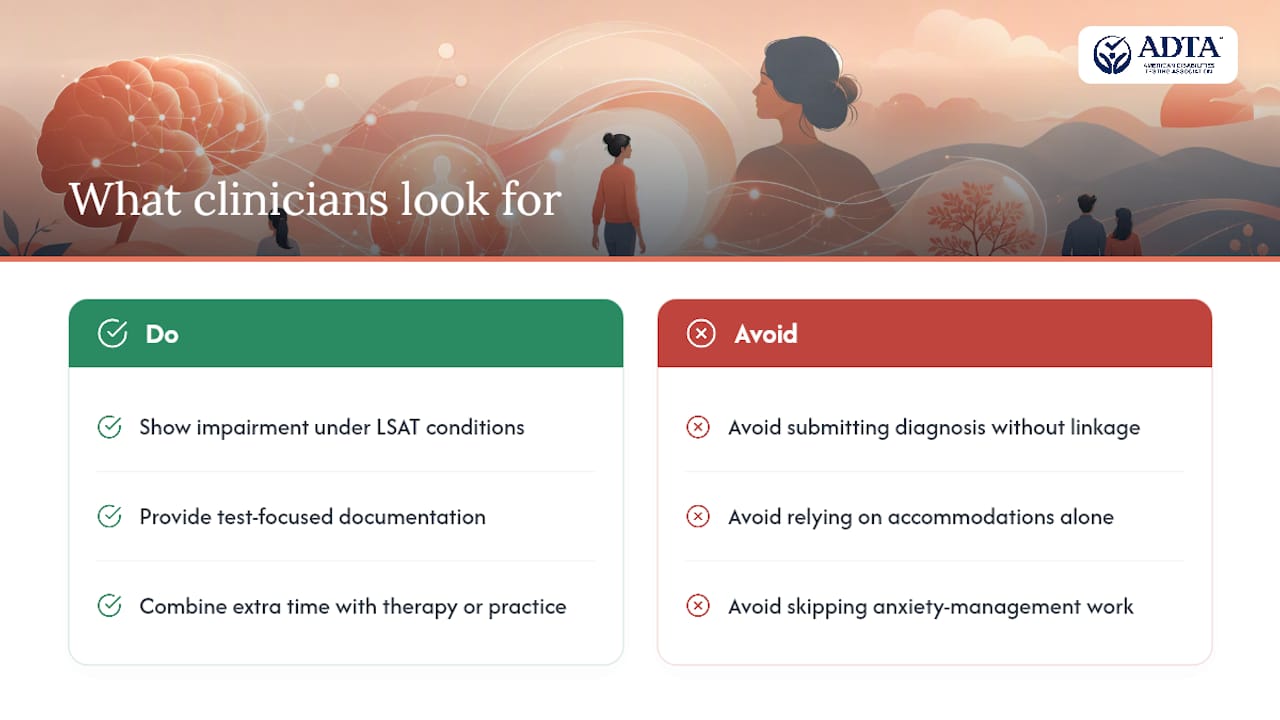
Clinicians who review LSAC applications regularly encounter evaluations that describe a diagnosis accurately but fail to connect it to the specific demands of timed, high-stakes testing. LSAC reviewers are not looking for a diagnosis in isolation; they are looking for evidence that the condition functionally impairs performance under the exact conditions the LSAT creates. An evaluation that does not address that link, even a thorough one, creates grounds for denial.
The other pattern worth naming: accommodations work best when students treat them as one part of a preparation strategy, not the whole strategy. The students who report the greatest relief are typically those who combined extended time with active anxiety-management work, whether through therapy, structured practice, or both. Accommodations aim to measure your aptitude, not your ability to manage clinical symptoms under pressure. That distinction matters for how you prepare.
Get your LSAT documentation prepared by licensed clinicians
If you have anxiety or a related condition that affects your LSAT performance, the documentation you submit to LSAC determines whether you receive the accommodation, and how much time you get. A strong evaluation connects your diagnosis to the specific functional demands of timed testing, specifies the appropriate time amount, and meets LSAC’s format requirements.

LSAT Accommodations by ADTA provides licensed psychologist evaluations and complete LSAC-ready documentation packets, including support for extended time, additional breaks, removal of the experimental section, and remote testing. The process includes a 100% money-back guarantee if your request is denied by either the clinician or LSAC. No prior diagnosis is required to start. To begin, complete the intake form and a clinician will review your situation. Documentation must be grounded in clinical evidence that matches the time amount you request; the evaluation process is designed to build exactly that record.
This article provides general information about testing accommodations and is not a substitute for professional clinical or legal advice. Confirm current LSAC requirements directly with LSAC or a qualified professional before submitting your request.
Useful sources
- Documentation Requirements | The Law School Admission Council
- Accommodations That May Be Available on the LSAT | The Law School Admission Council
- JAAPL article (testing accommodations, psychiatric/legal aspects)
- Extended Time as a Testing Accommodation: Its Effects and Perceived Consequences
- Extended Time Accommodation and the Academic, Behavioral, and Psychological Outcomes of Students With Learning Disabilities
- WCER Working Paper No. 2003-1
- Frontiers | Extended time on an unspeeded assessment improves neither test anxiety nor performance
Recommended
- LSAT Extended Time for Anxiety: Your 2026 Guide | LSAT Accommodations
- Why Remote Testing Improves LSAT Performance for Anxiety | LSAT Accommodations
- How Accommodations Help Anxious LSAT Test-Takers Perform | LSAT Accommodations
- Why Accommodations Level the Testing Field for LSAT | LSAT Accommodations