
How Accommodations Help Anxious LSAT Test-Takers Perform

Test accommodations are formal adjustments intended to give candidates with documented disabilities an equal opportunity to demonstrate their legal reasoning ability. For candidates whose anxiety-related symptoms create functional limitations under timed testing conditions, accommodations such as extended time, additional breaks, or remote-testing exceptions may be requested from LSAC when supported by appropriate clinician documentation. LSAC reviews each request and makes the final decision.
What types of accommodations help anxious LSAT students?
Anxiety creates specific, measurable barriers during the LSAT. The right accommodations target those barriers directly, not the test content itself.
Extended time is the most requested and most impactful accommodation for anxiety. Research shows that double time eliminates the negative effects of strict time limits on anxious test-takers, producing scores that reflect actual competence rather than panic-driven rushing. Time pressure is one of the primary triggers for anxiety spirals during the LSAT, and removing that pressure changes the testing experience entirely.
Remote Testing from Home
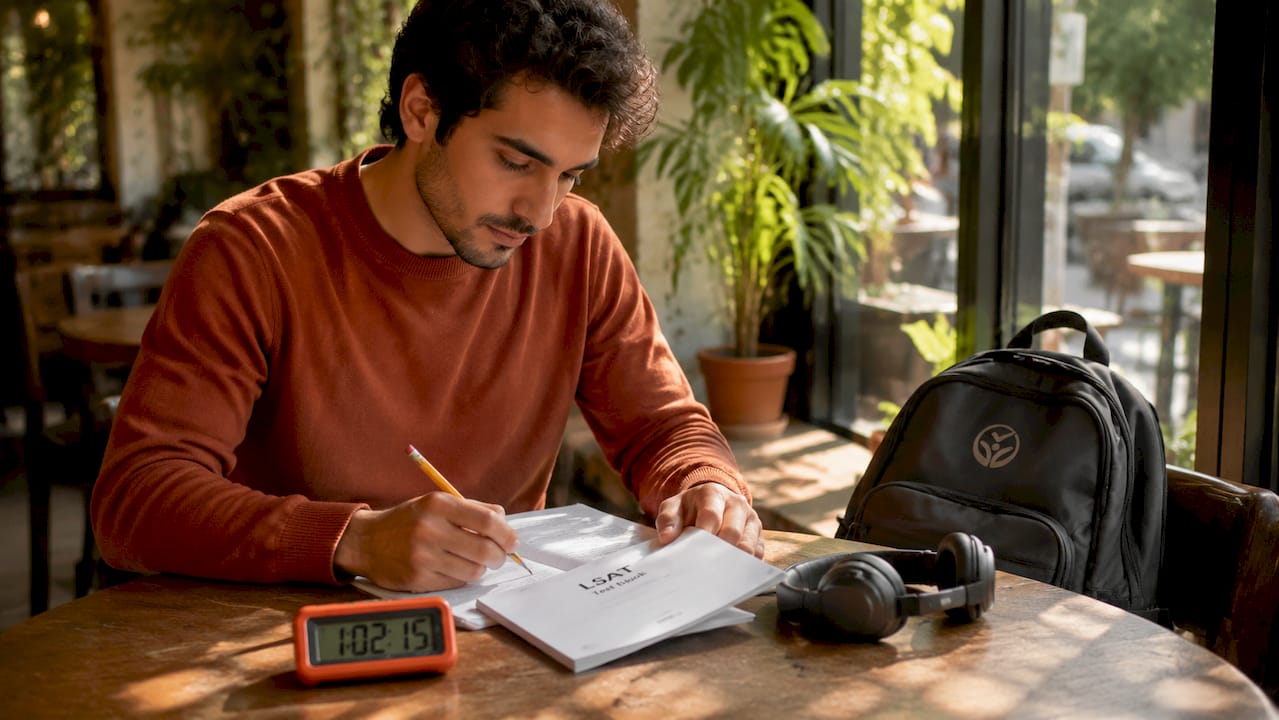
The ability to test remotely from home (eliminating unfamiliar environments which activate the nervous system in ways that compound anxiety), is extremely helpful to many test takers with anxiety. Remote testing from home is recognized as an effective accommodation for high-stakes assessments, especially on the LSAT where every second counts. Remote testing reduces anxiety-related performance drops by removing the physical stressors of a testing center. Testing from a familiar environment can lower baseline anxiety before the exam even begins.
As-needed breaks
As-needed breaks (up to 60 minutes) may help alleviate the physical symptoms of anxiety. Racing heart, shallow breathing, and muscle tension build over a long exam. Breaks give the nervous system a chance to reset before those symptoms derail concentration.
-
Extended time: reduces time-pressure spirals and allows careful, deliberate processing
-
As-needed breaks (up to 60 minutes): allow physical symptoms to subside before they disrupt focus
-
Remote testing: removes the testing center environment as an anxiety trigger
Pro Tip: Request every accommodation that applies to your functional limitations, not just the one you feel most comfortable asking for. LSAC evaluates each request on its merits, and a well-documented request for multiple accommodations is no less credible than a single-item request.
How does anxiety affect LSAT performance?
Anxiety does not just feel bad. It physically impairs the cognitive functions the LSAT measures. Working memory shrinks under stress, processing speed drops, and the ability to hold multiple logical relationships in mind simultaneously degrades. These are not character flaws. They are neurological responses to perceived threat.
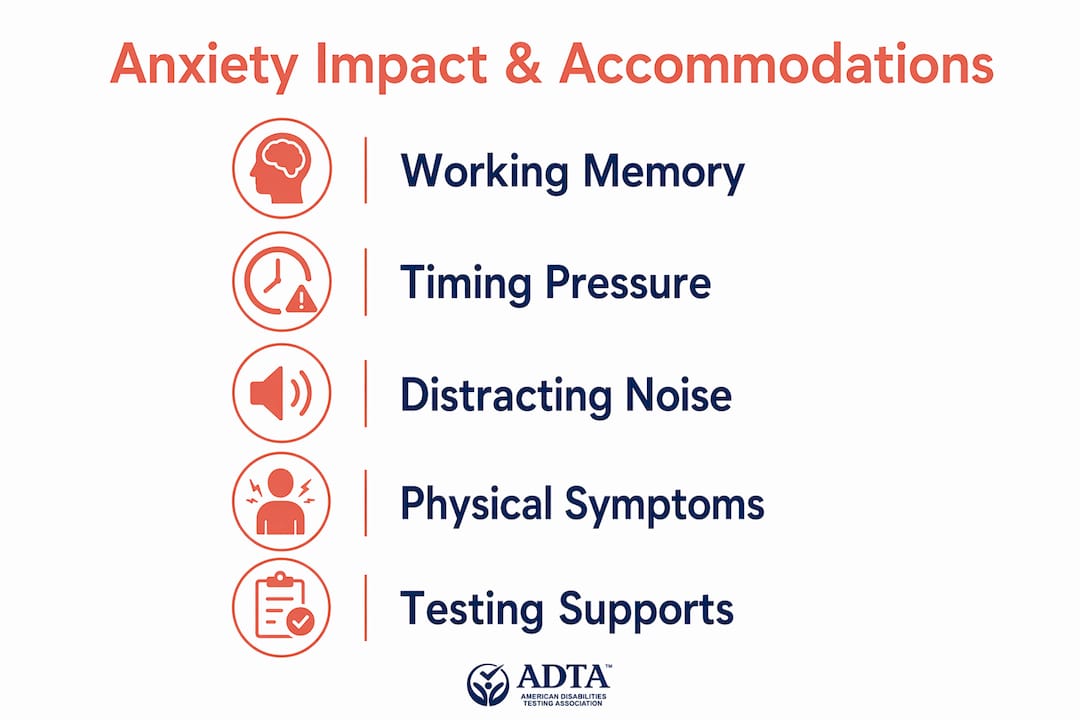
The LSAT is a timed, high-stakes exam that measures logical reasoning and reading comprehension under pressure. For candidates without anxiety, time pressure is a challenge. For candidates with anxiety disorders, time pressure is a trigger that activates the fight-or-flight response. That response redirects cognitive resources away from reasoning and toward threat detection. The result is a score that reflects the anxiety, not the candidate’s legal reasoning ability.
ADA testing accommodations exist precisely to prevent this outcome. The standard is clear: testing entities must provide accommodations that measure the candidate’s abilities, not their disability. Without accommodations, an anxious test-taker is effectively being tested on how well they manage anxiety under pressure, not on whether they can think like a lawyer.
| Anxiety symptom | Effect on LSAT performance | Accommodation that helps |
|---|---|---|
| Impaired working memory | Difficulty tracking logical chains across questions | Extended time |
| Racing thoughts | Loss of focus mid-passage | Scheduled breaks |
| Physical symptoms (heart rate, tension) | Disrupted concentration and stamina | Breaks, remote testing |
| Environmental sensitivity | Distraction from ambient noise or movement | Remote testing from home |
| Anticipatory dread of testing center | Elevated baseline anxiety before the exam starts | Remote testing from home |
The table above shows that each accommodation targets a specific, functional impairment. This framing matters when you apply. LSAC responds to documentation that connects symptoms to specific test-taking barriers, not just a diagnosis on a form.
How do you apply for LSAT accommodations for anxiety?
The application process is more straightforward than most candidates expect. The key is documentation that describes what anxiety does to your test-taking ability, not just what anxiety feels like.
-
Identify your functional limitations. Write down specifically how anxiety affects you during timed, high-stakes tasks. Examples: “I lose track of logical sequences when I feel rushed,” or “Physical symptoms like chest tightness force me to stop reading and restart.” These concrete descriptions are what LSAC needs.
-
Get a clinician evaluation. A licensed mental health professional must document your diagnosis and, critically, connect your symptoms to specific functional limitations. Clinician statements that directly link anxiety to test-taking barriers are the foundation of a successful request. A diagnosis alone is not enough.
-
Request specific accommodations. Your documentation should name the accommodations you need and explain why each one addresses a specific barrier. “Extended time because time pressure triggers acute anxiety that impairs working memory” is stronger than “extended time for anxiety.”
-
Submit through LSAC’s official process. LSAC reviews accommodation requests before you register for a test date. Plan ahead. The review process takes time, and submitting early gives you room to respond to any requests for additional documentation.
-
Know that prior accommodations are not required. ADA eligibility does not depend on a history of formal accommodations in school. Current documentation that demonstrates functional limitations is sufficient. Many candidates who never received accommodations in college qualify for LSAT accommodations.
Pro Tip: Review the LSAT documentation best practices guide before you order your clinical evaluation. Knowing what LSAC looks for helps you formulate your answers appropriately and helps produce stronger documentation the first time.
The most common mistake anxious candidates make is describing their diagnosis rather than their limitations. Concrete self-advocacy is the most effective path to approval. You do not need legal expertise. You need specific, honest descriptions of how anxiety affects your ability to perform under timed test conditions.
What are the common misconceptions about LSAT accommodations?
Several fears keep qualified candidates from applying. Each one is worth addressing directly.
-
“Accommodations give me an unfair advantage.” They do not. Accommodations level the playing field by removing barriers caused by disability. They do not change what the LSAT measures or lower the standard. A candidate who earns a strong score with extended time has demonstrated the same legal reasoning ability as a candidate who earns the same score without it.
-
“My score will be flagged.” Modern ADA policy strongly does not allow flagging scores earned with accommodations. Law schools receive your score, not a notation that you tested with accommodations. The stigma concern is largely outdated.
-
“I need a long history of accommodations to qualify.” This is false. A history of informal or formal accommodations is not required. Current documentation that links your anxiety to specific functional limitations is what matters.
-
“Applying means I’m admitting I can’t handle law school.” Applying means you understand your needs and advocate for yourself. That is exactly the kind of self-awareness and proactive thinking that law schools value.
Accommodations are not a workaround. They are a recognized legal right under the ADA, designed to produce valid, fair assessments for every candidate.
Key Takeaways
Test accommodations for anxiety remove specific functional barriers so that LSAT scores reflect legal reasoning ability, not the impact of an anxiety disorder.
| Point | Details |
|---|---|
| Accommodations are equity tools | They remove anxiety-related barriers without changing test content or scoring standards. |
| Extended time is the most impactful | Double time eliminates the negative effect of time pressure on anxious test-takers’ scores. |
| Prior accommodations are not required | Current documentation linking anxiety to functional limitations is sufficient for ADA eligibility. |
| Documentation must be well drafted | A clinician who specializes in LSAT accommodation paperwork already knows all of the pitfalls and ins and outs when filling out the forms. |
| Score flagging is not a concern | Modern ADA policy does not allow flagging scores earned with accommodations. |
What I’ve seen anxious LSAT candidates get wrong
Working with candidates through the American Disabilities Testing Association, I have watched genuinely capable people underperform on the LSAT not because they lacked legal reasoning ability, but because they refused to apply for accommodations they clearly needed. The reasons are always the same: fear of stigma, doubt about whether they “qualify,” or a belief that needing accommodations means they are not cut out for law school.
The uncomfortable truth is that anxiety is one of the most underaccommodated conditions in high-stakes testing. Candidates with anxiety often look fine from the outside. They have strong GPAs. They prep for months. And then they sit down in a testing center, the clock starts, and everything they prepared for becomes inaccessible because their nervous system is in crisis mode.
The candidates who do best are the ones who plan early, document thoroughly, and treat the accommodation request as part of their test preparation, not an afterthought. I have seen candidates go from scores that did not reflect their ability to scores that opened doors at top law schools, simply because they had the time and environment they needed to think clearly.
My advice: do not wait until after a disappointing score to consider accommodations. Apply before your first attempt. The intake process is straightforward, and the documentation support available through LSAT Accommodations means you are not navigating it alone. Accommodations are not a concession. They are preparation.
— American Disabilities Testing Association
How LSAT Accommodations supports your application
Anxious LSAT candidates often know they need accommodations but do not know where to start with documentation. LSAT Accommodations handles the hardest part: connecting you with licensed clinicians who understand exactly what LSAC requires and preparing documentation that meets those standards.
The process starts with a simple intake form that takes minutes to complete. From there, LSAT Accommodations coordinates your evaluation, prepares your documentation, and supports your submission. The result is a complete, clinician-backed accommodation request built to LSAC’s specifications. LSATaccommodations.com helps eligible candidates access licensed-psychologist documentation when clinically supported. Covered requests are backed by ADTA’s 100% money-back guarantee if LSAC denies 50% or 100% extra time after the documentation and appeal process is complete.
FAQ
What accommodations does LSAC grant for anxiety?
LSAC grants accommodations including extended time, additional breaks, and remote testing for candidates with documented anxiety disorders. Each accommodation must be supported by clinician documentation linking the anxiety to specific functional limitations.
Do I need a prior history of accommodations to qualify?
No. The ADA does not require a history of formal accommodations. Current documentation from a licensed clinician that demonstrates how anxiety impairs your test-taking ability is sufficient for eligibility.
Will law schools know I tested with accommodations?
Law schools receive your LSAT score, not a notation about accommodations. Modern ADA policy does not permit score flagging, so your accommodation status remains confidential.
Can remote testing count as an LSAT accommodation for anxiety?
Yes. Remote or online testing is a recognized accommodation option that reduces anxiety by removing the physical stressors of a testing center environment. Candidates should request it explicitly and support the request with explanations for why the testing center environment worsens their anxiety.