
LSAT Extended Time for Anxiety: Your 2026 Guide

LSAT extended time is a formal accommodation granted by the Law School Admission Council (LSAC) that gives eligible candidates additional time to complete each test section. For candidates with anxiety disorders, this accommodation can mean the difference between a score that reflects their true ability and one distorted by panic, racing thoughts, or physical symptoms that spike under timed pressure. LSAC recognizes anxiety as a qualifying condition, but approval depends entirely on the quality of your documentation. The two most common extensions are 50% extra time and double time (100% extra), and knowing which one you qualify for starts with understanding how LSAC evaluates your specific functional limitations.
What is LSAT extended time accommodation?
LSAT extended time is defined as a disability accommodation that increases the time allotted per section beyond the standard 35 minutes. A 50% extension brings each section to approximately 52.5 minutes. Double time brings it to 70 minutes per section. LSAC grants these extensions only when a candidate demonstrates that a documented disability creates a functional barrier to performing under standard timed conditions.
Anxiety disorders qualify under LSAC’s disability framework when they produce measurable, documented limitations. A general statement that you “feel nervous during tests” does not meet the standard. LSAC requires clinical evidence showing that your anxiety disorder impairs specific cognitive or physical functions during timed performance tasks.

The accommodation serves as a correction. The goal is to remove the barrier your disability creates.
Does anxiety qualify for LSAT extended time?
Anxiety qualifies for LSAT extended time when it produces functional limitations that directly affect timed test performance. LSAC does not require a specific anxiety diagnosis label. What it requires is an evaluation from a medical professional stating that your condition impairs functions like sustained concentration, working memory, processing speed, or stamina under time pressure.
Some conditions that most commonly support approval include:
-
Generalized Anxiety Disorder (GAD): Documented cognitive interference, including intrusive worry and difficulty sustaining focus, that worsens under timed conditions
-
Panic Disorder: Physical symptoms such as heart palpitations, shortness of breath, or dissociation triggered by test pressure
-
Social Anxiety Disorder: Significant performance anxiety that disrupts cognitive function in formal testing environments
-
PTSD with anxiety features: Hypervigilance or avoidance responses that impair concentration during high-stakes tasks
Typical accommodations for anxiety include extended time, additional breaks, and remote testing from home for a reduced-distraction testing environment. These reflect the most common functional barriers anxiety creates.
How do you apply for LSAT extended time accommodations?
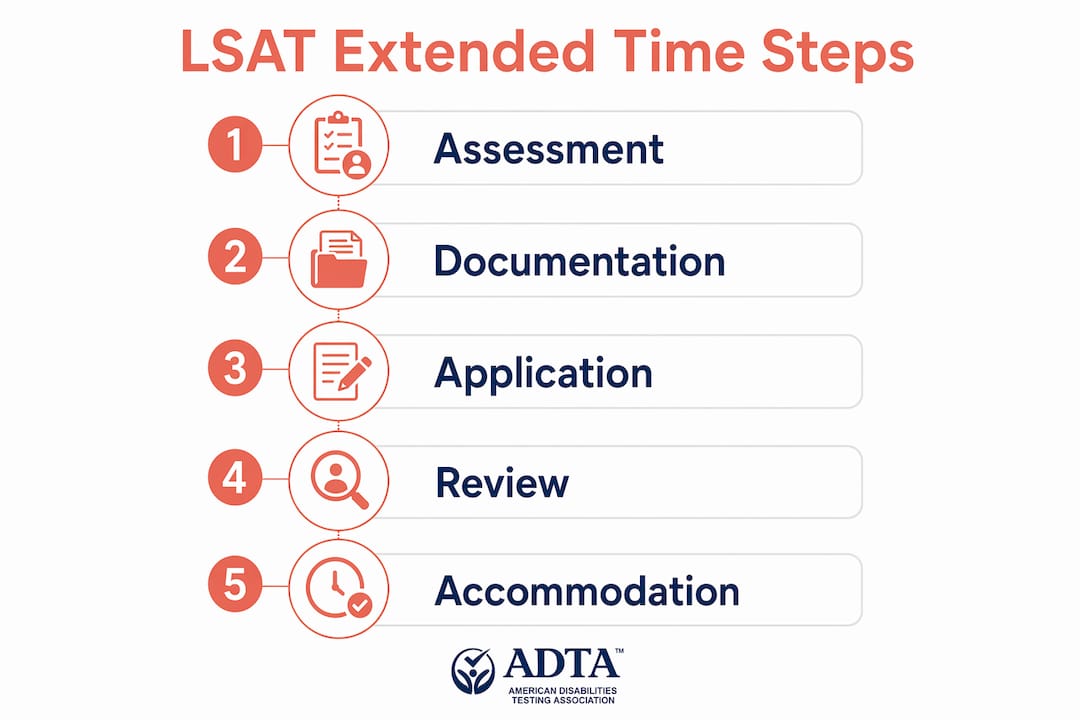
The application process runs through your LSAC online account. Here is the sequence that gives your request the strongest foundation:
-
Create or log into your LSAC account. The accommodation request portal is inside your account dashboard. You cannot submit documentation separately from this system.
-
Gather clinical documentation before you apply. Your evaluation must come from a licensed psychologist or psychiatrist. It must include your diagnosis, how the diagnosis was established, how it limits your function under timed conditions, and the specific accommodations your provider recommends.
-
Submit your request well before your target test date. Approval timelines can be lengthy, and delays affect your ability to schedule. The deadline to submit your accommodation request is the same date as the last day to register for the LSAT.
-
Review your documentation for specificity before submitting. Vague provider notes are the leading cause of denial. Your clinician’s letter must explicitly state the diagnosis, how it was established, and how it limits timed testing performance. Using a clinician that specializes in LSAT accommodations may help you not be denied.
-
Match your request to your documentation. Requesting maximum extended time without documentation support leads to denial. Ask for what your evaluation actually supports.
-
Respond promptly if LSAC requests additional information. LSAC may ask for supplemental documentation. A slow response can push your approval past your test date.
Candidates with anxiety should have clinical evaluations from qualified psychiatrists or psychologists. The functional impact statement is what LSAC actually evaluates, which certain doctors specialize in filling out.
Pro Tip: Ask your clinician to describe your limitations in behavioral terms, not just clinical language. “Patient experiences significant cognitive slowing and intrusive thoughts that prevent completion of timed tasks” is far stronger than “patient has anxiety.”
For a detailed breakdown of what strong documentation looks like, the LSAT documentation best practices guide covers what LSAC reviewers actually look for.
Common misconceptions about LSAT extended time for anxiety
Several persistent myths cause candidates to either avoid applying or apply incorrectly. Getting the facts straight protects your time and your test date.
-
Myth: Law schools will view accommodated scores negatively. LSAC does not flag scores as accommodated on score reports sent to law schools. Schools receive your score, not your testing conditions.
-
Myth: You need a prior diagnosis to apply. LSAC does not require a pre-existing diagnosis. A new evaluation from a licensed clinician that meets LSAC’s documentation standards is sufficient.
-
Myth: Anxiety is too mild to qualify. Severity is determined by functional impact, not by how anxious you feel subjectively. It is up to your clinician to determine what you qualify for.
Additional accommodations such as extra breaks, remote testing from home, screen readers, or separate testing rooms are sometimes granted alongside extended time, depending on individual documented needs. Breaks are particularly relevant for anxiety candidates because sustained performance over a long test day can compound anxiety symptoms in ways that a single time extension does not fully address.
Key Takeaways
LSAT extended time is a documented, category-based accommodation that requires precise clinical evidence of functional limitations, not just a diagnosis, to earn approval from LSAC.
| Point | Details |
|---|---|
| Anxiety qualifies with documentation | LSAC accepts anxiety disorders when clinical records show functional limitations on timed performance. |
| Scores improve dramatically on average | Accommodated candidates see an average score increase of about 10-20 points, reflecting fairness, not advantage. |
| Functional impact beats diagnosis alone | Documentation must describe how anxiety limits specific cognitive or physical functions during timed tasks. |
| Apply early | Submit your accommodation documentation before your test’s last date to register for the test. |
What I’ve learned from watching candidates navigate this process
Working with candidates through the accommodation process has shown me one consistent pattern: the applications that fail almost always fail on documentation, not eligibility. The candidate genuinely qualifies. Their clinician genuinely believes they qualify. But the letter reads like a standard referral note, not a functional limitations analysis. LSAC reviewers are not reading for sympathy. They are reading for evidence.
The candidates who succeed treat their documentation like a legal brief. The clinician does not just say “this patient has anxiety.” The clinician says “this patient’s anxiety produces X symptom under timed conditions, which impairs Y cognitive function, which directly affects their ability to complete Z type of task within standard time limits.”
I have also seen candidates undersell themselves out of fear that requesting accommodations looks like an admission of weakness. That fear is understandable and completely unfounded. Accommodations exist because the standard testing format is not neutral for everyone. Requesting what you are entitled to is not gaming the system. It is using the system correctly.
Start early. Work with a clinician who understands LSAC’s standards. And do not let the process intimidate you into submitting a weaker request than your condition warrants.
— American Disabilities Testing Association
How LSAT Accommodations supports your extended time request
Getting the documentation right is the hardest part of the process, and it is where most applications fall short.

LSAT Accommodations, provided by the American Disabilities Testing Association, offers evaluation and documentation services built around LSAC’s documentation requirements. Licensed psychologists assess whether an accommodation request is clinically supported and, when appropriate, prepare documentation for submission to LSAC. LSAC makes the final decision, and extra-time requests are backed by ADTA’s 100% money-back guarantee if LSAC denies 50% or 100% extra time after the documentation and appeal process is complete.
If you are ready to move forward, start your intake here and get your documentation process underway before your target test date.
FAQ
Does anxiety qualify for LSAT extended time?
Yes. LSAC recognizes anxiety disorders as qualifying conditions when clinical documentation demonstrates that the disorder creates functional limitations on timed test performance.
How much extra time does LSAT extended time provide?
If you work with the right clinician and you qualify, you may qualify for up to 100% extra time, as well as an extra hour of breaks that you may take at any time during the test.
What documentation does LSAC require for anxiety accommodations?
LSAC requires a clinical evaluation from a licensed psychologist or psychiatrist that states the diagnosis, how it was established, how it limits timed test performance, and the specific accommodations recommended. Vague provider notes rarely succeed.
Will law schools know I tested with extended time?
No. LSAC does not flag accommodated scores on the score reports sent to law schools. Schools receive only your score.
Can I get breaks in addition to extended time?
Yes. Additional accommodations such as extra breaks, ability to test remotely, or a separate testing room may be granted alongside extended time when documented functional limitations support them.