
LSAT Writing Sample Purpose: What You Need to Know

The LSAT writing sample is a required argumentative essay that tests your ability to reason logically, organize evidence, and write persuasively under timed conditions. Understanding what is LSAT writing sample purpose gives you a real advantage in law school admissions. The Law School Admission Council (LSAC) mandates this essay for every test taker, and your LSAT score will not be released until an approved writing sample is on file. This is not optional paperwork. It is a core part of your application that admissions committees actively review.
What is the LSAT writing sample purpose?
The LSAT writing sample is defined as a mandatory, unscored argumentative essay administered separately from the multiple-choice LSAT sections. Its purpose is to give law schools a proctored, timed, unassisted writing sample they can use to evaluate your communication skills. No AI tools, no editors, no second drafts. What you produce in that session is what admissions committees see.
The essay tests three foundational skills: argument construction, logical reasoning, and written organization. These are the same skills you will use in law school from day one. A first-year law student who cannot build a clear argument from competing evidence will struggle in every seminar and moot court session. The writing sample gives schools an early signal of whether you are ready for that environment.

LSAC requires the writing sample to be completed and approved before your score is released to any school. The sample must be completed within one year of your LSAT date and remains valid for five years. Many applicants underestimate this requirement and face delays in their applications as a direct result.
What is the format and structure of the LSAT argumentative writing task?
The current format, updated in 2024, presents you with a debatable issue and three to four distinct perspectives. Your job is to take a clear position, defend it with reasoning and examples, acknowledge the strongest counterargument, and conclude with a restatement of your stance. This is not a summary exercise. It is a persuasive writing task with a defined structure.
The 50-minute time window breaks down as follows:
-
Prewriting (15 minutes): Read the prompt carefully, identify the core tension between perspectives, and outline your argument. Skipping this step is the most common mistake test takers make.
-
Essay drafting (35 minutes): Write your full response. Lead with a clear thesis, build your argument with specific reasoning, address the opposing view directly, and close with a firm conclusion.
-
Review (use remaining time): Check for clarity, logical flow, and any glaring errors. You will not have time for a full rewrite, so prioritize coherence over perfection.
You access the writing task through the JD Services portal, which becomes available eight days before your multiple-choice LSAT date. You can complete it before or after your scored exam, but you cannot release your score without it.
Pro Tip: Complete the writing sample before your test date if possible. Finishing it early removes one source of post-test stress and prevents score release delays that could affect application deadlines.
Why do law schools require the LSAT writing sample?
Law schools require the writing sample because it gives them something no other application component can: a verified, unassisted writing baseline. Your personal statement goes through multiple revisions with advisors and editors. Your writing sample does not. That distinction matters more now than it ever has.
Admissions committees use the writing sample to verify the authenticity of your personal statement by comparing the two. A polished personal statement paired with an incoherent writing sample raises an immediate red flag. Schools are increasingly aware of AI-assisted writing in applications, and the proctored writing sample is their clearest tool for detecting a mismatch.
The writing sample also functions as a tiebreaker. When two applicants have nearly identical GPAs and LSAT scores, the writing sample can tip the decision. Admissions committees evaluate it for:
-
Clarity of argument: Does your thesis appear early and stay consistent throughout?
-
Quality of reasoning: Do your supporting points actually connect to your position?
-
Organization: Does the essay move logically from introduction to conclusion?
-
Professionalism: Is the tone appropriate for a legal academic setting?
-
Counterargument handling: Do you acknowledge and address the opposing view without abandoning your stance?
An incomplete or incoherent sample can raise serious concerns in an admissions review. Schools interpret a weak writing sample as a warning sign about your readiness for law school writing demands.
How has the LSAT writing sample changed with the 2024 update?
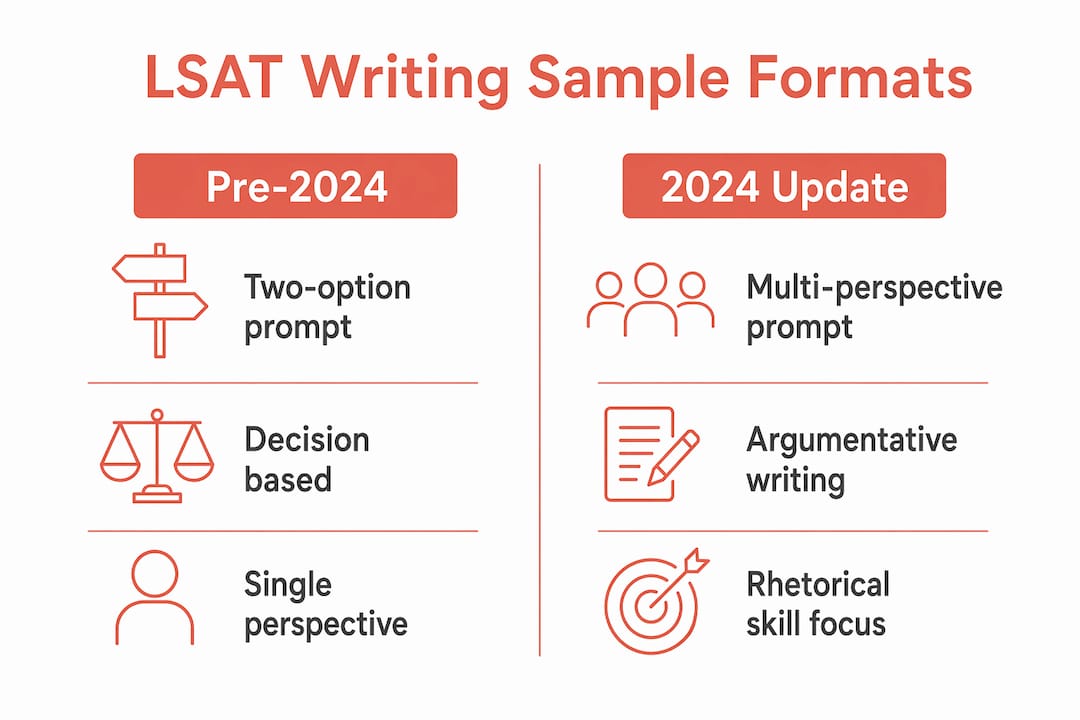
The 2024 update replaced the older two-option decision prompt with a multi-perspective argumentative writing format. Under the old format, you chose between two options and defended your choice. The new format presents three to four perspectives on a debatable issue and asks you to synthesize them into a coherent argument.
| Feature | Pre-2024 format | 2024 format |
|---|---|---|
| Prompt type | Two-option decision | Multi-perspective issue |
| Perspectives provided | 2 | 3–4 |
| Primary skill tested | Decision justification | Argument synthesis |
| Law school skill alignment | Limited | Direct |
This shift to argumentative writing mirrors the kind of writing you will do in law school. Legal briefs, memos, and seminar papers all require you to engage with multiple competing positions, not just pick a side between two options. The new format is harder, but it is also a more honest test of whether you are ready for that work.
The update also allows admissions committees to assess rhetorical and evidentiary skills more thoroughly. Can you weigh conflicting evidence? Can you build a position that holds up against the strongest objection? These are the questions the new format is designed to answer.
Pro Tip: Practice with multi-perspective prompts before your test date. Find a debatable policy issue, write out three positions on it, then draft a 35-minute essay defending one. This mirrors the actual task more closely than generic essay practice.
What practical advice should prospective law students follow?
The single most important piece of advice is to take the writing sample seriously. Many applicants treat it as a formality because it is unscored. That is a mistake. Admissions experts consistently advise that the writing sample demonstrates foundational argumentation skills that law schools expect from day one.
Follow these practices to perform at your best:
-
Take a clear stance immediately. Fence-sitting reads as indecision. Pick a position in your first paragraph and commit to it. Admissions readers want to see that you can make a judgment call and defend it.
-
Outline before you write. Use your 15 prewriting minutes to map your thesis, two to three supporting points, and your counterargument response. An essay written without an outline tends to drift.
-
Acknowledge the strongest counterargument. Ignoring opposing perspectives weakens your essay. Address the best objection to your position and explain why your argument still holds.
-
Write for a legal audience. Use formal but clear language. Avoid slang, hedging phrases, and vague generalizations. Every sentence should advance your argument.
-
Submit early to avoid score delays. The processing window after submission can take several days. If you wait until after your test to complete the writing sample, your score release could be delayed by a week or more, which can affect rolling admissions decisions.
Pro Tip: Time yourself strictly during practice sessions. Writing under a real 35-minute clock feels very different from open-ended drafting. Build that pressure into your preparation from the start.
Key takeaways
The LSAT writing sample is a mandatory, proctored essay that law schools use as a verified baseline for evaluating your reasoning, organization, and writing authenticity in the admissions process.
| Point | Details |
|---|---|
| Mandatory for score release | LSAC will not release your LSAT score until an approved writing sample is on file. |
| Unscored but reviewed | Admissions committees read the sample to assess clarity, reasoning, and professionalism. |
| Tiebreaker in close decisions | A strong writing sample can tip a decision when two applicants are otherwise equally matched. |
| 2024 format is more demanding | The multi-perspective argumentative format directly mirrors law school writing assignments. |
| Submit early | Delays in completing the sample can hold up your score release and affect application timelines. |
The writing sample deserves more respect than it gets
Most applicants I have seen treat the writing sample as a box to check. They rush through it after their scored exam, write whatever comes to mind, and move on. That approach is a real missed opportunity.
The writing sample is the only part of your application that admissions committees know you wrote alone, under pressure, without help. That is not a minor detail. It is the most authentic piece of writing in your entire file. Law schools know this. The rise of AI-assisted personal statements has made them rely on it even more.
What I have found is that applicants who prepare for the writing sample the same way they prepare for logical reasoning, with timed practice, structured outlines, and deliberate counterargument work, produce essays that genuinely stand out. The bar is low because most people do not prepare. Clearing it takes less effort than you think, but it requires treating the task as real work, not an afterthought.
Mastering this section also builds skills you will use immediately in law school. The ability to read competing arguments, take a defensible position, and write it clearly under time pressure is exactly what your first-year professors will demand. Starting that practice now, before orientation week, puts you ahead of most of your incoming class.
— American
How Lsataccommodations can support your LSAT writing process
If anxiety affects your ability to write clearly under timed conditions, the writing sample can feel like a significant obstacle. Extended time and additional breaks can make a real difference in how you perform on this section.

Lsataccommodations specializes in documentation services for test takers with anxiety-related conditions. The process is designed to be straightforward, with a 100% money-back guarantee if your request is denied. Licensed clinicians familiar with LSAC guidelines handle your evaluation. You can start your accommodations intake today to get the process moving before your test date. Visit Lsataccommodations to learn more about what extended time and remote testing options can do for your performance.
FAQ
Is the LSAT writing sample scored?
The LSAT writing sample is not scored on a numeric scale, but it is required and reviewed by admissions committees at law schools.
When does the LSAT writing sample become available?
The writing task becomes available through the JD Services portal eight days before your multiple-choice LSAT date and can be completed before or after your exam.
Can my LSAT score be released without the writing sample?
No. LSAC will not release your LSAT score to any law school until an approved writing sample is on file.
How long is the LSAT writing sample valid?
The writing sample must be completed within one year of your LSAT date and remains valid for five years from the date of completion.
Do law schools actually read the LSAT writing sample?
Yes. Admissions committees use the writing sample to evaluate reasoning and organization, verify writing authenticity against personal statements, and as a tiebreaker for closely matched applicants.