
Why Remote Testing Improves LSAT Performance for Anxiety

Why remote testing improves LSAT performance for candidates with anxiety disorders
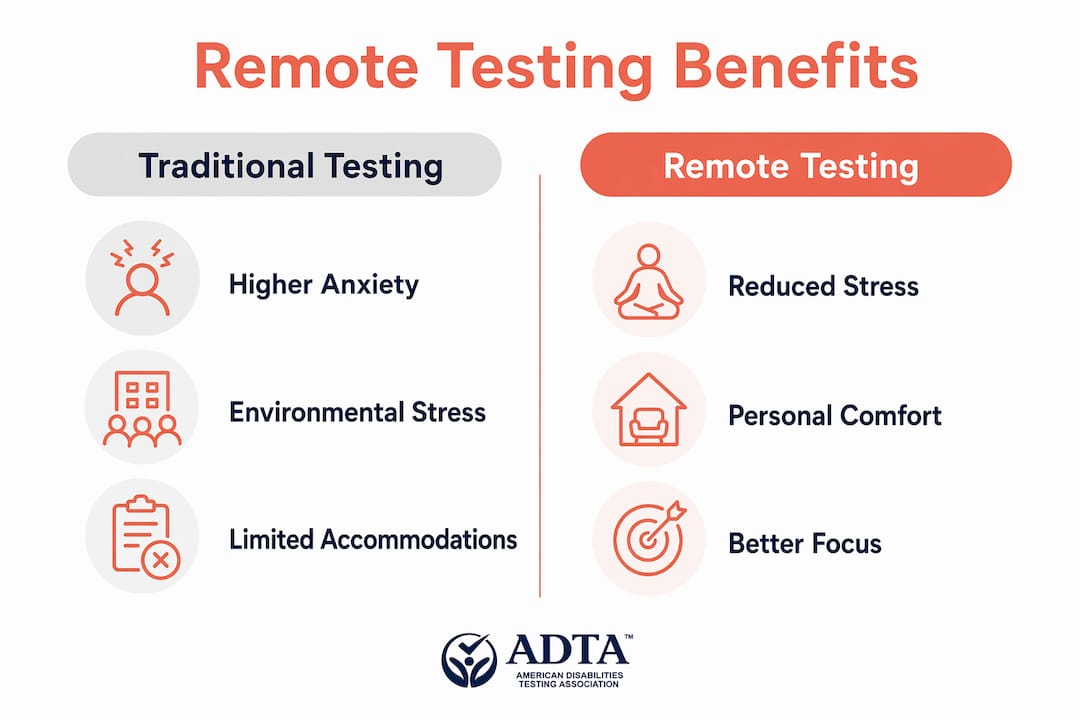
Remote testing improves LSAT performance for candidates with anxiety disorders by removing the environmental triggers that activate the brain’s stress response and consume the working memory you need to reason clearly. The benefits are not subtle. When anxiety goes unmanaged in a crowded test center, it directly degrades the cognitive systems the LSAT is designed to measure.
Here is why the format shift matters so much for anxious candidates:
- Working memory protection. Anxiety floods the mental workspace needed for logical reasoning and reading comprehension. A familiar home environment reduces the cognitive load that stress adds on top of the test itself.
- Social-evaluative threat eliminated. Testing alongside strangers creates a layer of self-consciousness that compounds anxiety, especially for candidates with social anxiety disorder. A private setting removes that pressure entirely.
- Fight-or-flight suppression. Remote environments lower the environmental stressors that trigger cortisol and adrenaline release, keeping the prefrontal cortex functioning at a higher level.
- Access to self-regulation tools. At home, you can use breathing exercises, grounding techniques, or brief movement between sections without drawing attention or violating test center protocols.
- Reduced pre-test arousal. No commute, no parking stress, no unfamiliar building. Lower baseline anxiety before the first question means more cognitive resources available when the clock starts.
The Law School Admission Council (LSAC) recognizes remote testing as a valid accommodation exception for candidates with documented disability-related needs, which means this is not just a comfort preference. It is a medically supported testing modification.
Table of Contents
- How anxiety hijacks the cognitive skills the LSAT actually tests
- How a remote setting reduces anxiety’s grip on your test performance
- What LSAC’s current remote testing policy actually allows
- Practical challenges to weigh before choosing remote testing
- How specialized documentation services improve your approval odds
- Expert insights on anxiety reduction techniques in remote settings
- What the research shows about performance differences
- Technical requirements and environment setup for remote LSAT testing
- Psychological and logistical preparation strategies for remote LSAT testing
- Key Takeaways
How anxiety hijacks the cognitive skills the LSAT actually tests
Anxiety consumes working memory capacity, and working memory is the engine behind every section of the LSAT. When anxious thoughts occupy that mental workspace, you have less capacity left for holding logical premises, tracking reading comprehension arguments, or shifting between problem-solving strategies. The test gets harder not because the questions changed, but because your brain is running with half its processing power diverted to threat monitoring.
The physiological side compounds the cognitive side. Elevated heart rate, tremors, and shallow breathing all pull attention away from the passage you are trying to analyze. A 30-year meta-analysis of test anxiety research found consistent negative effects on academic performance, with effect sizes that grew larger as task complexity increased. The LSAT sits at the top of that complexity scale.
Attentional narrowing is another mechanism worth understanding. Anxiety restricts your attentional breadth, which on the LSAT means missing qualifiers like “except,” “most,” or “primarily” in reading comprehension, or overlooking a critical constraint in analytical reasoning. These are not careless errors. They are the predictable result of an anxious brain prioritizing threat signals over test content.
Pro Tip: If you notice your score dropping significantly under timed conditions compared to untimed practice, that gap is often working memory interference from time pressure, not a knowledge deficit. Document it. That contrast is exactly what LSAC reviewers look for in accommodation requests.
How a remote setting reduces anxiety’s grip on your test performance
The most direct benefit of remote testing is the elimination of social-evaluative threat. In a test center, the awareness that others can see your visible anxiety symptoms, shaking hands, sweating, or losing your place, creates a second layer of stress on top of the test itself. At home, that layer disappears.
A familiar environment also supports self-regulation in ways a test center cannot. You can position your workspace exactly as you practiced. You can use the same chair, the same lighting, the same ambient conditions you trained in. That consistency lowers pre-test arousal and makes anxiety-management techniques easier to execute when you need them mid-section.
- Reduced travel stress means you arrive at the test mentally fresher, not already depleted from logistics.
- Break flexibility lets you use approved break time for breathing exercises or brief movement without an audience.
- Environmental control allows you to eliminate noise variables that a test center proctor cannot address on your behalf.
- Predictability reduces anticipatory anxiety, because you already know exactly what the space looks, sounds, and feels like.
Research confirms that accommodations like extended time and private rooms restore performance toward baseline for candidates with genuine disabilities rather than inflating scores. The goal of remote testing as an accommodation is the same: let your score reflect your ability, not your anxiety level.
What LSAC’s current remote testing policy actually allows
Starting with the August 2026 LSAT, LSAC has moved toward in-center testing for almost all candidates. Remote testing is now limited to two groups: candidates with certain approved disability-related accommodations, and those who live more than 180 miles or three hours of driving time from a domestic Prometric testing center.
For anxiety-related accommodation requests, the path to remote testing runs through LSAC’s disability documentation process. Key requirements include:
- Documented functional impairment. LSAC requires clinical documentation that links your anxiety symptoms directly to measurable LSAT performance impairment, not just a diagnosis.
- Case-by-case review. Decisions are final and made individually. Approval for remote testing does not follow automatically from an anxiety diagnosis.
- Second camera requirement. Candidates approved for remote testing starting in August 2026 must use a smartphone as a second camera during the session.
- Technical and environmental compliance. Your testing space must meet LSAC’s environment standards, including a private, quiet room and a secure internet connection.
- Deadline adherence. Documentation and accommodation requests must be submitted by the applicable administration deadline. Late submissions are not reviewed.
Practical challenges to weigh before choosing remote testing
Remote testing is not automatically the right choice for every anxious candidate. Some candidates find that technical concerns introduce a new category of stress that offsets the environmental benefits.
- Internet reliability anxiety. Worrying about your connection dropping mid-section is a real stressor for candidates who already struggle with catastrophic thinking.
- Home environment unpredictability. Roommates, pets, deliveries, and background noise can disrupt concentration in ways a test center proctor would handle for you.
- Proctoring discomfort. Being watched through a webcam bothers some candidates more than testing alongside strangers.
- Equipment setup pressure. The second-camera requirement and system checks add procedural steps that can feel overwhelming on test day without rehearsal.
- Individual trigger differences. Some candidates genuinely perform better in a structured, external environment where the formality of the setting helps them focus.
A community discussion among LSAT candidates reflects this split clearly. Some report significantly lower anxiety at home; others describe the technical uncertainty as its own source of dread. Knowing your personal triggers is the deciding factor, not a general assumption that home is always calmer.
How specialized documentation services improve your approval odds
Getting approved for remote testing as an anxiety accommodation depends almost entirely on the quality of your documentation. LSAC reviewers need to see a clear, clinical connection between your anxiety symptoms and specific LSAT performance impairments. A vague diagnosis letter does not meet that standard.
- Functional impairment evidence. Effective documentation quantifies the gap between your untimed and timed performance, describes specific cognitive symptoms like mind-blanking, and ties them to LSAT-relevant tasks.
- Licensed clinician evaluation. The evaluation must come from a qualified professional who understands both anxiety disorders and LSAC’s documentation criteria.
- Tailored accommodation recommendations. Generic requests are less persuasive. Documentation that specifies why remote testing addresses your particular symptom profile carries more weight.
- Early submission. LSAC recommends submitting three to four months before your target test date. Last-minute requests rarely receive thorough review.
LSAT Accommodations by ADTA, through LSATaccommodations.com, specializes in exactly this documentation process for anxiety-related conditions. The service reports a 98% LSAC approval rate and backs every evaluation with a 100% money-back guarantee if the request is denied. Clinicians familiar with LSAC’s standards prepare the documentation, which means the connection between your symptoms and your testing impairment is built into the evaluation from the start.
Expert insights on anxiety reduction techniques in remote settings
Dr. Alberto Galia notes that remote testing environments better accommodate anxiety management because candidates can apply techniques privately without disrupting others or drawing attention. Extended break time, a common accommodation, creates space for progressive muscle relaxation, deep breathing, and brief mindfulness exercises that are difficult to execute discreetly in a shared test center.

The physiological case for these techniques is grounded in how stress hormones affect the prefrontal cortex. Cortisol directly impairs the brain region responsible for working memory and executive function. Techniques that lower cortisol during breaks, even briefly, help restore the cognitive capacity you need for the next section. Remote testing makes those techniques accessible in a way that in-center testing rarely does.
What the research shows about performance differences
Research on how accommodations help anxious test-takers consistently shows that modified conditions restore performance closer to a candidate’s actual ability rather than inflating it. Extended time and private testing rooms compensate for anxiety-related impairments without conferring unfair advantages on accommodated candidates.
The meta-analysis referenced earlier found that interventions targeting anxiety directly, not just additional test preparation, produced meaningful performance improvements. Remote testing functions as one such intervention by addressing the environmental triggers that activate anxiety in the first place. Candidates who level the testing field through appropriate accommodations tend to score closer to what their untimed practice results predict.
Technical requirements and environment setup for remote LSAT testing
Meeting LSAC’s technical standards is not optional. Candidates who fail environment or equipment checks on test day risk having their session invalidated.
Your setup needs to satisfy these requirements before test day:
- A private, quiet room with no other people present and no background noise sources you cannot control.
- A stable, secure internet connection with sufficient bandwidth to maintain a live proctored session without interruption.
- A smartphone positioned as a second camera, required starting with the August 2026 administration for all remote-approved candidates.
- A compatible computer that passes LSAC’s system check, which should be run well before the test date, not the morning of.
- A cleared desk with only permitted materials, as the proctor will conduct an environment scan before the session begins.
Run a full technical rehearsal at least one week before your test date. Discovering a compatibility issue the night before is exactly the kind of stressor that spikes anxiety and undermines everything you prepared for.
Psychological and logistical preparation strategies for remote LSAT testing
Preparation for remote testing with an anxiety disorder requires two parallel tracks: the logistical and the psychological. Neither works without the other.
On the logistical side, complete your accommodation documentation early, confirm your technical setup weeks in advance, and do at least two full practice tests in your actual remote testing space under real timed conditions. Familiarity with the environment is one of the strongest anxiety-reduction tools available. For additional context on how standardized testing accommodations fit into the broader admissions picture, reviewing guidance from admissions professionals can help you frame the process realistically.
On the psychological side, work with a therapist or counselor on the specific anxiety triggers the LSAT activates. Cognitive behavioral techniques that target test-specific catastrophic thinking are particularly effective. Practice your anxiety-management techniques during timed practice sessions, not just outside of them, so they become automatic under pressure. If you are pursuing extended time for anxiety, understand exactly how that time will be distributed across sections so there are no surprises on test day.
Key Takeaways
Remote testing improves LSAT performance for anxiety-affected candidates by reducing the environmental stressors that impair working memory and cognitive focus, with LSAC recognizing remote testing as a valid accommodation exception for documented disability-related needs.
| Point | Details |
|---|---|
| Anxiety impairs working memory | Anxious thoughts consume the mental workspace needed for LSAT logical reasoning and reading comprehension. |
| Remote testing reduces key stressors | Eliminating social-evaluative threat and travel stress lowers baseline anxiety before the first question. |
| LSAC limits remote access in 2026 | Remote testing is now restricted to candidates with approved disability accommodations or those over 180 miles from a test center. |
| Documentation quality drives approval | Clinical evidence must link anxiety symptoms directly to measurable LSAT performance impairment, not just provide a diagnosis. |
| Expert services reach 98% approval | LSAT Accommodations by ADTA reports a high LSAC approval rate and offers a money-back guarantee for denied requests. |
Ready to pursue your accommodation and test in the environment where you actually perform your best?

LSAT Accommodations by ADTA handles the clinical evaluation and documentation preparation so your request reflects the full picture of how anxiety affects your performance. With an approval rate of 98% and a money-back guarantee, the risk of waiting is higher than the risk of starting. Begin your intake today and give yourself the testing conditions your abilities deserve.