
Why Accommodations Level the Testing Field for LSAT

Testing accommodations are defined as adjustments to exam conditions that eliminate barriers caused by disabilities, ensuring scores reflect a test-taker’s true abilities rather than impairment. For LSAT candidates with anxiety disorders, this distinction is the difference between a score that represents their legal reasoning skills and one that represents how anxiety hijacks their performance under pressure. Federal law under 28 C.F.R. § 36.309 mandates exactly this standard. Understanding why accommodations level the testing field is the first step toward using them effectively.
Why accommodations level the testing field for LSAT candidates with anxiety
Anxiety does not reduce intelligence or legal reasoning ability. What it does is interfere with the conditions under which those abilities can be demonstrated. Time pressure is the most common trigger. When a test-taker with generalized anxiety disorder or panic disorder faces a strict clock, the brain’s threat response activates, pulling cognitive resources away from reasoning and toward survival. The LSAT, with its dense logical reasoning sections and rigid timing, creates exactly that kind of pressure.

The most common LSAT accommodations for anxiety include extended time at 50% or 100% above the standard limit, scheduled breaks between sections, a private or reduced-distraction testing room, and the option to test remotely. Each of these adjustments targets a specific way that anxiety disrupts performance. Extended time reduces the “speededness” effect, which is the phenomenon where time constraints lower test validity for candidates whose processing is impaired by anxiety or depression. A research finding on speededness confirms that time-limited tests reduce validity for these groups, making accommodations a measurement correction rather than a favor.
The purpose of these accommodations is not to make the test easier. The purpose is to make the test accurate.
- Extended time (50%–100%): Reduces the cognitive load of racing the clock, allowing reasoning ability to surface.
- Scheduled breaks: Interrupt the anxiety cycle between sections, preventing cumulative stress from compounding across the exam.
- Private testing room: Eliminates environmental triggers like ambient noise, movement, and the presence of other test-takers.
- Remote testing option: Allows candidates to test in a familiar, controlled environment where anxiety is more manageable.
Pro Tip: If you have used accommodations in any prior academic setting, document them now. Prior accommodations from an IEP or 504 Plan carry significant weight in LSAC’s review process.
What laws require fair testing conditions?
The Americans with Disabilities Act is the legal foundation for testing accommodations in the United States. Under ADA requirements, any entity that offers high-stakes exams must administer those exams in a way that accurately reflects the skills being measured, not the limitations caused by a disability. This applies directly to the Law School Admission Council, which administers the LSAT.
The specific regulation is 28 C.F.R. § 36.309. It requires testing entities to provide modifications, accommodations, or auxiliary aids unless doing so would fundamentally alter what the exam measures or impose an undue burden on the organization. “Fundamental alteration” is a high bar. Giving a candidate extra time does not change what the LSAT measures. It changes only the conditions under which measurement occurs.
The ADA’s core principle for testing: Exam scores must reflect individual aptitude and achievement, not the functional limitations of a disability. Any testing practice that conflates the two violates the law.
Prior accommodations matter significantly in this process. Documentation of prior accommodations such as an IEP or 504 Plan is heavily weighted in LSAC’s review. This is because prior accommodations establish a pattern of recognized need, reducing the burden on the candidate to prove impairment from scratch. Testing entities also cannot impose unnecessary delays or demand documentation beyond what is reasonably needed. Doing so constitutes a violation of the ADA’s equal opportunity standard.
The law does not guarantee approval of every request. What it guarantees is a fair, timely, and evidence-based review process. That distinction matters when you are preparing your documentation.
How do accommodations differ from modifications?
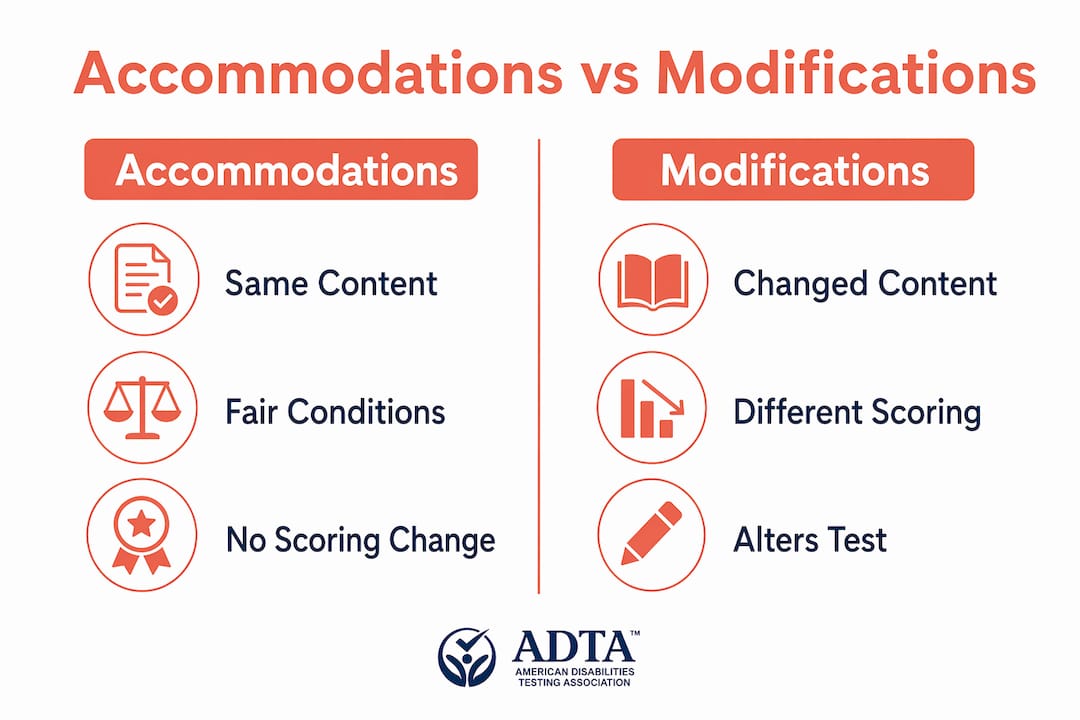
Accommodations and modifications are not the same thing, and the difference is critical for understanding why accommodations preserve test validity. An accommodation changes how a test is accessed without changing what the test measures or the standard required to pass. A modification changes the content, expectations, or scoring criteria of the exam itself.
| Feature | Accommodation | Modification |
|---|---|---|
| Changes test content | No | Yes |
| Changes scoring standard | No | Yes |
| Alters testing conditions | Yes | Yes |
| Preserves score comparability | Yes | No |
| Example | Extended time, private room | Removing entire test sections |
This distinction is why accommodations maintain test integrity rather than undermining it. A candidate who receives 50% extended time still answers the same questions, at the same difficulty level, with the same scoring rubric as every other test-taker. The only difference is that the time constraint no longer functions as an artificial barrier to demonstrating ability.
A common misconception is that accommodations give candidates an unfair advantage. The professional and legal consensus is the opposite. Accommodations remove a disadvantage that was never part of what the LSAT intends to measure. The LSAT measures logical reasoning, analytical thinking, and reading comprehension. It does not measure how well a candidate performs under anxiety-induced time pressure. Accommodations correct for that confound.
How do you get LSAT accommodations for anxiety?
The LSAC accommodation request process requires clinical documentation that is both current and specific to timed testing conditions. Vague or outdated notes from a general practitioner will not meet the standard. Effective documentation must include a formal diagnosis, a description of the evaluation process used to reach that diagnosis, a clear account of functional limitations, and a direct justification for each accommodation requested.
The functional impairment description is the most critical element. LSAC reviewers need to understand not just that you have anxiety, but how anxiety specifically impairs your performance on timed, high-stakes exams. A clinician who writes “patient reports test anxiety” provides far less support than one who writes “patient experiences significant cognitive interference, including intrusive thoughts and attentional disruption, under timed testing conditions, consistent with generalized anxiety disorder.”
Follow these steps to build a strong request:
- Get a current clinical evaluation. Evaluations must be recent. Outdated or vague evaluations weaken requests significantly. Work with a licensed clinician who understands LSAC’s documentation standards.
- Document functional impairment, not just diagnosis. The evaluation must describe how your anxiety affects performance specifically in timed test settings, not just in daily life.
- Gather prior accommodation records. Collect IEP documents, 504 Plans, and any records of accommodations received in undergraduate or graduate settings.
- Request specific accommodations with justification. Each accommodation you request must be tied directly to a documented functional limitation. Requesting extended time requires evidence that time pressure specifically worsens your performance.
- Submit early. LSAC’s review process takes time. Submitting well before your intended test date reduces the risk of delays affecting your schedule.
Pro Tip: LSAT Accommodations works with licensed clinicians who specialize in LSAC documentation standards. A clinician familiar with LSAT extended time requirements will write evaluations that speak directly to what LSAC reviewers need to see.
No clinician can guarantee LSAC approval. LSAC makes all final decisions independently. What strong documentation does is give your request the best possible foundation.
Key Takeaways
Accommodations level the testing field by correcting for barriers that prevent accurate measurement, not by lowering the standard the LSAT applies to every candidate.
| Point | Details |
|---|---|
| Legal mandate is clear | 28 C.F.R. § 36.309 requires LSAT scores to reflect aptitude, not disability-related impairment. |
| Anxiety impairs measurement | Time pressure triggers anxiety responses that reduce score validity, making accommodations a correction, not an advantage. |
| Accommodations preserve test integrity | Extended time and private rooms change testing conditions, not content or scoring standards. |
| Documentation must be specific | Functional impairment descriptions tied to timed testing conditions are the core of any strong LSAC request. |
| Prior accommodations carry weight | IEP and 504 Plan records significantly strengthen accommodation requests under LSAC’s review criteria. |
What I’ve learned about accommodations and the misconceptions that hold candidates back
The most damaging misconception I encounter is that requesting accommodations signals weakness or that it will somehow flag a candidate as less capable in the eyes of law schools. Neither is true. Law schools do not receive information about whether a candidate tested with accommodations. The score they see is simply a score.
The second misconception is that a diagnosis alone is enough to secure accommodations. A diagnosis is the starting point, not the finish line. What LSAC reviewers evaluate is the functional impact of that diagnosis on timed test performance. Candidates who arrive with a diagnosis but no functional impairment documentation consistently face denials that could have been avoided with better preparation.
The third misconception is that accommodations are a recent or controversial development. The ADA has required accessible testing since 1990. The debate over rising accommodation rates in higher education is real, but it has not changed the legal standard. Candidates with documented, genuine need are entitled to accommodations. The process exists to verify that need, not to discourage it.
My advice is simple: treat the accommodation request as seriously as you treat LSAT preparation itself. Start early, work with clinicians who know the process, and build documentation that speaks directly to timed testing conditions. The candidates who succeed are the ones who prepare their requests with the same rigor they bring to logic games.
— American Disabilities Testing Association
How LSAT Accommodations can support your request
Preparing an LSAT accommodation request for anxiety is a clinical and administrative process that most candidates have never navigated before. LSAT Accommodations, provided by the American Disabilities Testing Association, connects you with licensed clinicians who specialize in LSAC documentation standards.

The service covers evaluation, documentation preparation, and submission guidance, with a 98% LSAC approval rate and a 100% money-back guarantee if your request is denied. No prior diagnosis is required to begin. If you are ready to get started, submit your intake form and a clinician will review your situation and outline exactly what documentation your request needs. You can also visit LSATaccommodations.com to learn more about the full range of services available.
FAQ
What does it mean to level the testing field?
Leveling the testing field means adjusting exam conditions so that scores reflect a candidate’s actual abilities rather than the barriers created by a disability or anxiety disorder. Accommodations achieve this by removing obstacles that are not part of what the test measures.
Do LSAT accommodations give an unfair advantage?
No. Accommodations remove a disadvantage caused by a disability, not a skill gap. The LSAT still measures the same content at the same difficulty level for all candidates, regardless of accommodations.
What documentation does LSAC require for anxiety accommodations?
LSAC requires a current clinical evaluation that includes a formal diagnosis, a description of the evaluation process, and a specific account of how anxiety impairs performance under timed testing conditions. Vague or outdated documentation significantly weakens a request.
How long does the LSAC accommodation review process take?
LSAC does not publish a fixed timeline, but delays can occur when documentation is incomplete. Submitting your request well before your intended test date reduces the risk of scheduling conflicts caused by a prolonged review.
Can I request accommodations without a prior diagnosis?
You can begin the process without a prior diagnosis. A licensed clinician can conduct a current evaluation that establishes both the diagnosis and the functional impairment documentation LSAC requires. LSAT Accommodations offers this evaluation as part of its service.