
LSAT Test Format 2026 Explained for Prospective Law Students

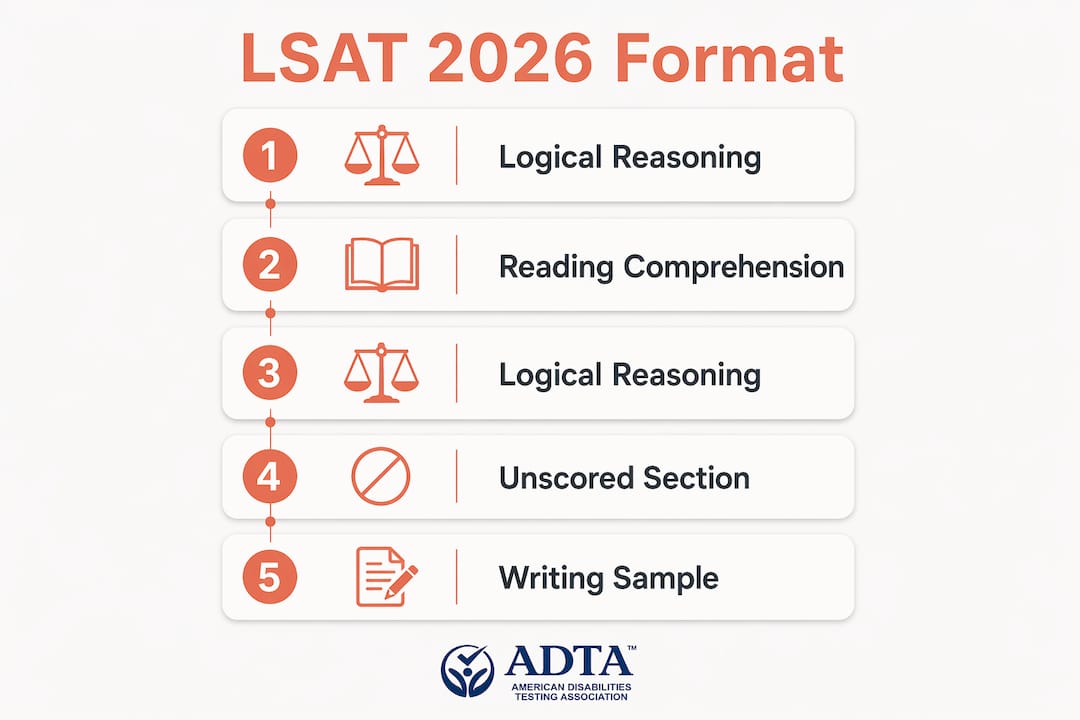
The LSAT test format 2026 explained: the exam consists of four 35-minute multiple-choice sections, two scored Logical Reasoning, one scored Reading Comprehension, and one unscored experimental section, plus a separate online writing sample. Starting august 2026, all test takers must sit the exam in person at Prometric test centers with a new digital interface that replaces the prior remote option for most candidates. The Logic Games section was retired in august 2024, making Logical Reasoning the dominant force on the exam. Understanding this structure is the first step toward building a preparation plan that actually works.
What are the LSAT test sections in 2026?
The 2026 LSAT structure totals approximately 77 scored questions across three scored sections. Each section runs exactly 35 minutes, and one additional unscored experimental section appears somewhere in the exam without any label identifying it.
Logical Reasoning
Logical Reasoning is the backbone of the 2026 LSAT. Two scored Logical Reasoning sections appear on every exam, each containing 24–26 questions. Together, they account for approximately 65–67% of your total scored questions, roughly 50 out of 77. That weighting means Logical Reasoning performance largely determines your final score.

Each question presents a short argument followed by a task: identify an assumption, find a flaw, strengthen or weaken a conclusion, draw an inference, or match a parallel argument. There are 14 main question types candidates must master, including assumptions, strengthen/weaken, inference, parallel reasoning, and method of argument. Skipping any of these categories in your prep leaves a real gap.
Reading Comprehension
One scored Reading Comprehension section contains approximately 26–28 questions spread across four passages. Three passages are standalone, and one is a comparative reading set presenting two shorter texts on a related topic. Questions test your ability to identify the main point, understand structure, draw inferences, and compare arguments across passages.
The passages cover law, humanities, natural sciences, and social sciences. You will not know which topic appears on your exam, so practicing across all four subject areas is necessary.
The experimental section
The experimental section is unscored and indistinguishable from the scored sections. It can be either Logical Reasoning or Reading Comprehension, and its position changes randomly throughout the exam. You will never know which section is experimental on test day. Treating every section as scored is the only safe approach.
Key facts about the 2026 LSAT sections at a glance:
-
Logical Reasoning (x2): 24–26 questions each, 35 minutes each, scored
-
Reading Comprehension (x1): 26–28 questions, 35 minutes, scored
-
Experimental section (x1): unscored, either LR or RC, 35 minutes, position unknown
-
Total scored questions: approximately 77
-
Mandatory break: 10 minutes after the second section
How is the LSAT 2026 different from prior years?
The 2026 LSAT reflects the most significant structural change in the exam’s recent history. The changes affect both content and delivery.
-
Logic Games removed. The Analytical Reasoning section, known as Logic Games, was retired in august 2024. It no longer appears in any form on the 2026 exam.
-
Second Logical Reasoning section added. To replace Logic Games, LSAC added a second scored Logical Reasoning section. This shifts roughly two-thirds of the exam’s weight onto argument analysis skills.
-
Scoring emphasis shifted. Reading Comprehension now carries less relative weight than it did when Logic Games existed. Logical Reasoning mastery is more critical than ever.
-
Return to in-person testing. Starting august 2026, mandatory in-person testing at Prometric centers replaced the remote option for most candidates. Limited exceptions exist for medical or distance-related reasons.
-
New digital User Interface. A redesigned test delivery platform launched with the 2026–27 testing cycle. The interface includes updated highlighting, underlining, and a new question navigation bar.
-
Overall timing unchanged. The total exam still runs approximately 2.5 hours, including the mandatory 10-minute break. The writing sample remains separate and completed online.
-
Writing sample unchanged. The LSAT Writing section continues as an unscored, online, proctored essay completed independently from the multiple-choice exam (it is there so that the admissions team at the university that you are applying to can see how well you write without the assistance of any outside resources).
The content difficulty of the exam has not changed. LSAC confirmed that the fundamental structure and difficulty remain consistent with the post-2024 format. The changes are structural and logistical, not a harder test.
Pro Tip: Do not spend extra prep time worrying about the UI changes. Spend 30 minutes in LawHub getting familiar with the new interface, then redirect your energy to Logical Reasoning content mastery.
What are the new digital interface and in-person testing conditions?
The 2026 test delivery platform introduces several concrete changes to how you interact with the exam on screen. Knowing these before test day prevents surprises.
The updated User Interface includes:
-
Full highlighting and underlining: You can now highlight or underline any text across all sections, including answer choices. Prior versions had limited highlighting functionality.
-
Redesigned question bar: The new bar displays all questions in a section and clearly marks flagged items, making navigation faster and more intuitive.
-
No single-click answer elimination: The prior radio-button elimination feature is gone. Adapting to this change is critical under timed conditions. You must use the new multi-step process for flagging and reviewing questions.
-
LawHub practice materials updated: All 60+ official PrepTests are now available in LawHub with the new interface. Practicing there is the only way to replicate actual test conditions.
For in-person testing logistics, Prometric centers operate on a first-to-register, first-to-schedule basis. Center slots are limited. Candidates who register late risk losing access to their preferred dates and locations. Approved exceptions for remote testing exist but require a special accommodation.
Pro Tip: Complete at least three full practice tests inside LawHub using the updated interface before your test date. Muscle memory for navigation matters when every second counts.
LSAC emphasizes that practicing in LawHub builds comfort with the new UI and supports test security. Candidates who skip official practice tools and use third-party software risk encountering an unfamiliar interface on test day.
How should you prepare for the 2026 LSAT format?
Effective preparation for the 2026 LSAT starts with accepting one fact: Logical Reasoning is the exam. Two-thirds of your score comes from those two sections. Every other preparation decision should follow from that reality.
Practical preparation steps:
-
Master all 14 Logical Reasoning question types. Assumptions, strengthen/weaken, inference, flaw, parallel reasoning, method of argument, and the rest each require a distinct approach. Identify your weakest types early using an error log review process and drill them specifically.
-
Practice Reading Comprehension consistently. One section still represents roughly one-third of your score. Do not neglect it because it carries less weight than before.
-
Treat every section as scored. Because the experimental section is unidentifiable, you must give full effort to all four sections. Mentally checking out during what you suspect is the experimental section is a real risk.
-
Use LawHub exclusively for timed practice. Third-party interfaces do not replicate the 2026 UI. Official PrepTests in LawHub are the only accurate simulation.
-
Build a timing strategy per section. At 35 minutes per section, you have roughly 1 minute 20 seconds per question on Logical Reasoning. Practice pacing until it becomes automatic.
-
Register early. Testing center slots fill quickly. Early registration secures your preferred date and location.
-
Complete the LSAT Writing section before test day. The writing sample must be done before your scores are released. Leaving it until the last minute adds unnecessary stress.
Pro Tip: Plan your 10-minute mid-test break in advance. Bring a snack, step away from the screen, and reset mentally. Candidates who use the break well consistently report better focus in the second half of the exam.
What is the LSAT Writing section and when do you complete it?
The LSAT Writing section is a separate, unscored, proctored essay completed online. It does not appear on test day with the multiple-choice sections. The purpose of this section is so that the admissions team at the university that you are applying to can see how well you write without the assistance of any outside resources.
The writing sample is available starting 8 days before your scheduled multiple-choice exam date. You complete it through a secure online proctoring platform at a time of your choosing within that window. The essay prompt presents a decision scenario with two options, and you argue for one using the provided criteria and facts. There is no single correct answer.
Key facts about the writing section:
-
Unscored: Law schools receive the essay but it does not contribute to your 120–180 score.
-
Sent to all schools: Every law school you apply to receives your writing sample alongside your LSAT score.
-
Valid for one year: The writing sample must be completed within one year of your test date for your scores to be processed.
-
Admissions significance: Many law schools review the essay for writing ability and reasoning clarity, even though it carries no numeric weight.
For a deeper look at how the essay fits into your application, the LSAT Writing sample guide from American Disabilities Testing Association covers its role in admissions in detail. Treat the writing sample as a real part of your application, not an afterthought.
Key Takeaways
The 2026 LSAT format places two-thirds of its scoring weight on Logical Reasoning, making mastery of all 14 question types the single most important preparation priority.
| Point | Details |
|---|---|
| Four sections, 35 minutes each | Two scored Logical Reasoning, one Reading Comprehension, and one unscored experimental section make up the exam. |
| Logical Reasoning dominates scoring | Approximately 65–67% of scored questions come from the two Logical Reasoning sections. |
| Logic Games are gone | The Analytical Reasoning section was retired in august 2024 and does not appear in 2026. |
| In-person testing required | Starting august 2026, most candidates must test at Prometric centers; register early to secure your slot. |
| Writing sample is separate | Complete the unscored online essay within 8 days before your test date; law schools receive it with your score. |
What the 2026 format changes actually mean for your prep
The removal of Logic Games was the right call, and the second Logical Reasoning section reflects what law school actually demands: the ability to analyze arguments quickly and accurately. At American Disabilities Testing Association, we work with candidates every day who spend weeks on Logic Games prep out of habit, not realizing the section no longer exists. That is wasted time.
The return to in-person testing is a bigger logistical shift than most candidates expect. Prometric centers vary in quality, noise level, and equipment. Visiting your assigned center before test day, if possible, removes one variable from an already high-stakes experience. Candidates who show up to an unfamiliar physical environment on test day carry an extra cognitive load they did not train for.
The new UI is genuinely better than the old one. The highlighting tools and question bar make navigation cleaner. But the loss of single-click answer elimination catches candidates off guard. Practice the new interface until the mechanics feel invisible. The goal is to think about arguments, not about how to flag a question.
One more thing: take the writing sample seriously. Law schools do read it. A well-reasoned, clearly written essay signals the same skills the LSAT measures. Candidates who dash it off in 20 minutes miss a real opportunity to reinforce their application.
— American Disabilities Testing Association
LSAT accommodations for the 2026 testing cycle
The shift to in-person testing at Prometric centers creates new challenges for candidates with disabilities, anxiety disorders, or other conditions that affect test performance. Extended time, additional breaks, and remote testing exceptions are all available through the LSAT accommodations process.

American Disabilities Testing Association, through LSATaccommodations.com, helps candidates document and apply for accommodations under the 2026 testing cycle requirements. The process includes evaluation by a licensed psychologist familiar with LSAC’s guidelines and is covered by the 100% money-back guarantee if your request is not approved by LSAC. Early applications matter more than ever given Prometric center scheduling constraints. Start your accommodations intake today to secure the testing conditions you need before slots fill.
FAQ
How many sections does the 2026 LSAT have?
The 2026 LSAT has four 35-minute sections: two scored Logical Reasoning, one scored Reading Comprehension, and one unscored experimental section. Total scored questions number approximately 77.
Is Logic Games still on the 2026 LSAT?
No. The Logic Games (Analytical Reasoning) section was permanently retired in august 2024 and does not appear on the 2026 exam in any form.
Can I take the 2026 LSAT from home?
If you apply for an LSAT accommodation with a licensed psychologist through a service such as LSATaccommodations.com, you may qualify to take the LSAT remotely from home. Otherwise, most candidates will have to test in person at a Prometric center starting August 2026.
When do I complete the LSAT Writing section?
The writing sample is available starting 8 days before your multiple-choice test date. You complete it online through a proctored platform and must finish it within one year of your test date for scores to be released.
What changed about the 2026 LSAT interface?
The 2026 UI adds full highlighting and underlining across all test text and a redesigned question navigation bar. It removes the single-click answer elimination feature present in prior versions. Practice in LawHub to adapt before test day.