
LSAT Error Log Review Process: Boost Your Score

The LSAT error log review process is a structured, multi-pass method for categorizing missed questions, diagnosing root causes, and building corrective actions that prevent repeated mistakes. Most test-takers track scores but never analyze why they miss questions. That gap is exactly where score gains hide. A disciplined error log review process transforms raw practice test data into a targeted study plan, and the difference between a 160 and a 170 often lives inside that analysis. The standard framework used by high scorers runs 90–120 minutes per test and covers three distinct review passes.
What does an effective LSAT error log actually require?
An effective error log captures five data points per missed question: question type, reason for the wrong answer choice, why the correct answer works, difficulty level, and what to do differently next time. Each field serves a specific purpose. Question type reveals which sections drain your score. The “what to do differently” field forces you to commit to a corrective action rather than just noting the mistake.
The tools you use matter less than the consistency of your entries. A simple spreadsheet with labeled columns works as well as any dedicated app. What kills most logs is overcomplication. Spending 10 or more minutes on a single entry is counterproductive. The target is 2–3 minutes per question, enough to capture the pattern and the fix without writing an essay.

Pro Tip: Use short tags like “time pressure,” “scope error,” or “negation trap” in your wrong-answer-reason column. Tags make it fast to sort entries by category later and spot recurring patterns without re-reading every note.
The table below shows the five required fields and practical tool options for each:
| Field | What to capture | Practical tool |
|---|---|---|
| Question type | LR, RC, or AR subtype | Spreadsheet column or app tag |
| Wrong answer reason | Why you chose the wrong option | Free-text note, 1 sentence max |
| Correct answer rationale | Why the right answer is correct | Free-text note, 1 sentence max |
| Difficulty level | Easy, medium, or hard | Single-word label or 1–3 scale |
| Action plan | One specific thing to do differently | Flashcard or drill note |
How does the three-pass LSAT error log review method work?
The three-pass review method is the most effective framework for extracting learning from a practice test. Each pass has a distinct goal, a fixed time budget, and a defined output. Running all three in sequence builds a dynamic training plan rather than a static list of wrong answers.
Pass 1: Initial categorization (15 minutes)
Mark every missed question and note the question type. Do not look at explanations yet. The goal is a clean inventory of what went wrong by category. This pass takes 15 minutes and gives you a map of where the test hurt you most.
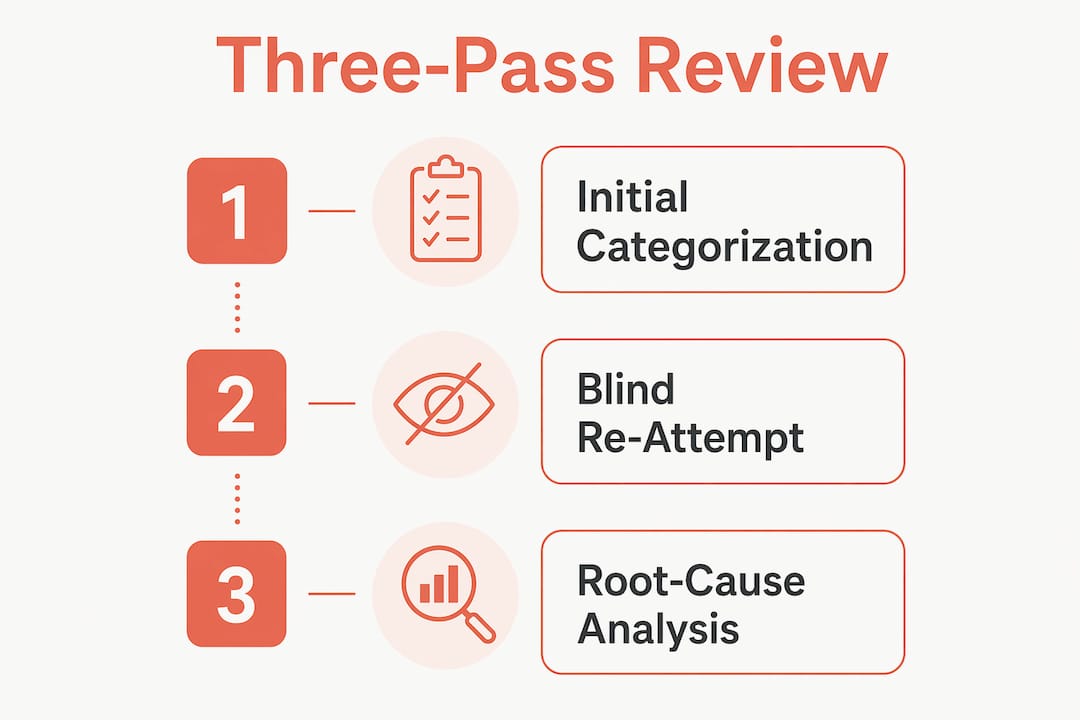
Pass 2: Blind re-attempt (30–45 minutes)
Blind review means re-attempting every missed question untimed and without seeing the answer first. This is the single most diagnostic step in the entire process. If you answer correctly when untimed but missed it during the test, the problem is pacing or carelessness, not a skill gap. If you still miss it untimed, a genuine conceptual weakness exists. That distinction changes everything about how you study next.
Pass 3: Root-cause analysis (45–60 minutes)
This pass is where the real work happens. For each question, write your five log fields and identify the root cause. Was the error caused by time pressure, a conceptual gap, a misread stimulus, or a cognitive bias like confirmation bias? Naming the cause precisely is what separates a useful log from a list of wrong answers. This pass produces the entries that drive your next week of focused drills.
Pro Tip: Schedule your review session within 24 hours of finishing a practice test. Memory of your reasoning during the test fades fast. The sooner you review, the more accurately you can reconstruct why you made each choice.
The table below compares the three passes at a glance:
| Pass | Time | Primary goal | Output |
|---|---|---|---|
| Pass 1 | 15 min | Categorize missed questions | Inventory by question type |
| Pass 2 | 30–45 min | Blind re-attempt untimed | Pacing vs. skill gap diagnosis |
| Pass 3 | 45–60 min | Root-cause analysis | Log entries with corrective actions |
How do you identify root causes and avoid common logging pitfalls?
Misreading a question is a symptom, not a diagnosis. The actual cause might be time pressure forcing a rushed read, a conceptual gap in understanding conditional logic, or a cognitive bias toward a familiar-sounding answer. Treating the symptom as the cause means you drill the wrong thing and the error repeats.
The most common pitfall in LSAT prep error analysis is building a static archive. Test-takers log errors once and never return to them. A log only creates value when you use it to triage your study time. The fix is a simple priority system:
-
If an error category appears once, note it and monitor.
-
If it appears twice, mark it as a study priority.
-
If it appears three times, build a targeted drill around it immediately.
This triage approach keeps your study time focused on high-impact weaknesses instead of spreading effort evenly across every question type.
Beyond triage, the most effective logs include what experts call recognition triggers. A recognition trigger is a one-line rule written in your own words that warns you early when a question matches a pattern you have missed before. An example: “When the stimulus uses ‘most,’ check whether the conclusion requires ‘all.’” These triggers are more useful than lengthy notes because they are fast to read and immediately applicable during a test.
Top scorers convert their log entries into flashcards, one card per lesson learned. This method uses active recall to build long-term retention of the patterns that cost points. A flashcard takes 60 seconds to make and pays dividends across every future practice test.
Pro Tip: Keep a separate “recurring errors” tab in your log. Move any error category that hits your triage threshold directly into that tab. Review it before every practice test so the patterns stay front of mind.
When and how often should you review your LSAT error log?
Review frequency determines whether your log stays a living tool or becomes a forgotten file. The right schedule balances depth with sustainability.
A daily practice session should end with a brief log update. Add new entries immediately after finishing a drill set or timed section. This takes 5–10 minutes and keeps the log current without creating a backlog.
A weekly deep dive should run 30–45 minutes. During this session, sort entries by category, check your triage thresholds, and plan the next week’s focused drills based on what the log shows. This is where you convert raw entries into a study plan.
Before each new practice test, spend 15 minutes reviewing recent log entries. This pre-test review primes your brain to recognize recurring traps during the test itself. It shifts your mindset from reactive to proactive pattern recognition.
-
Daily: Add new entries after each drill or timed section (5–10 minutes).
-
Weekly: Sort by category, check triage thresholds, plan drills (30–45 minutes).
-
Pre-test: Review recent entries to activate pattern recognition (15 minutes).
-
Post-test: Run the full three-pass review within 24 hours (90–120 minutes).
Pro Tip: Block your weekly deep dive on your calendar like a class. Test-takers who treat it as optional skip it when study fatigue hits. A fixed time slot removes the decision entirely.
Key Takeaways
A consistent LSAT error log review process, built around the three-pass method and root-cause triage, is the most direct path from repeated mistakes to measurable score gains.
| Point | Details |
|---|---|
| Use the three-pass method | Run a 90–120 minute review covering categorization, blind re-attempt, and root-cause analysis after every practice test. |
| Capture five fields per error | Log question type, wrong answer reason, correct answer rationale, difficulty, and a specific corrective action. |
| Triage by frequency | Mark errors as study priorities at two repeats; build targeted drills at three repeats to focus effort where it counts. |
| Build recognition triggers | Write one-line personal rules from each error to catch familiar traps early during future tests. |
| Review before every practice test | Spend 15 minutes reading recent log entries to activate pattern recognition before each timed session. |
What I have learned from watching test-takers build error logs
Most test-takers start their error log with genuine enthusiasm and abandon it within two weeks. The reason is almost never laziness. It is frustration. They log errors diligently, run another practice test, and miss the same question type again. That moment feels like the log is not working. What is actually happening is that they logged the symptom and drilled the wrong thing.
The shift that changes everything is moving from description to diagnosis. Writing “I missed this because I misread the stimulus” is description. Writing “I misread the stimulus because I was 4 minutes behind pace and skimming” is diagnosis. The second entry tells you exactly what to fix. The first one just makes you feel bad.
Honesty is the other variable most test-takers underestimate. It is tempting to write a generous explanation for a wrong answer, one that makes the error sound like a close call rather than a gap. A log built on flattering entries produces a flattering but useless picture of your weaknesses. The log only works when you write the uncomfortable truth.
Dynamic pattern recognition, not volume of entries, drives score improvement. A log with 20 honest, well-diagnosed entries beats a log with 200 vague ones every time. Keep entries short, keep them honest, and let the triage system tell you where to focus. The score gains follow from that discipline, not from the size of the spreadsheet.
— American
How LSAT Accommodations from ADTA supports your LSAT preparation
Test anxiety is one of the most common root causes that shows up in error logs, especially in timed sections where performance drops sharply compared to untimed blind review. If your log consistently shows a gap between your untimed and timed accuracy, anxiety may be a factor worth addressing directly.

LSAT Accommodations, provided by the American Disabilities Testing Association, specializes in documentation services for test-takers with anxiety-related conditions and other mental health conditions. The service connects eligible candidates with licensed psychologists who evaluate whether LSAT accommodations documentation is supported and, when appropriate, prepare official documentation for LSAC requests involving extended time, additional breaks, or remote-testing exceptions. LSAC makes the final decision on every request, and covered requests are backed by ADTA’s 100% money-back guarantee if LSAC denies qualifying extra-time accommodations after the documentation and appeal process is complete. If your error log points to a performance gap driven by anxiety or other mental health condition, start the intake process to find out whether accommodations apply to your situation.
FAQ
What is the LSAT error log review process?
The LSAT error log review process is a structured method for categorizing missed questions, diagnosing root causes, and building corrective actions after each practice test. The standard framework runs 90–120 minutes and uses three sequential review passes.
How many fields should each error log entry include?
Each entry should capture five fields: question type, reason for the wrong answer, why the correct answer works, difficulty level, and a specific action plan. These five fields are the minimum needed for pattern recognition and targeted improvement.
What is blind review and why does it matter?
Blind review means re-attempting missed questions untimed before checking the answer key. It reveals whether an error came from pacing and carelessness or from a genuine conceptual gap, which determines the correct study response.
How often should I review my LSAT error log?
Add new entries daily after each drill, run a 30–45 minute weekly sort to plan focused drills, and spend 15 minutes reviewing recent entries before every practice test. The full three-pass review runs within 24 hours of each practice test.
When should I turn an error category into a targeted drill?
Mark an error category as a study priority the second time it appears. Build a targeted drill around it the third time it appears. This triage system keeps your study time focused on the weaknesses that cost the most points.