
The LSAT Scoring Calculator Explained (2026 Update): Raw Score to Scaled Score 120–180

The LSAT scoring calculator translates your raw score (the number of questions you answered correctly) into a scaled score on the 120–180 range. Your final scaled score is what law schools see and what determines your percentile rank. The national average LSAT score sits at approximately 151–152 (50th percentile). Understanding exactly how the calculator works gives you a massive edge when planning your prep and setting realistic targets.
How does an LSAT scoring calculator work?
An LSAT scoring calculator converts your raw score (the number of questions you answered correctly) into a scaled score on the 120–180 range.
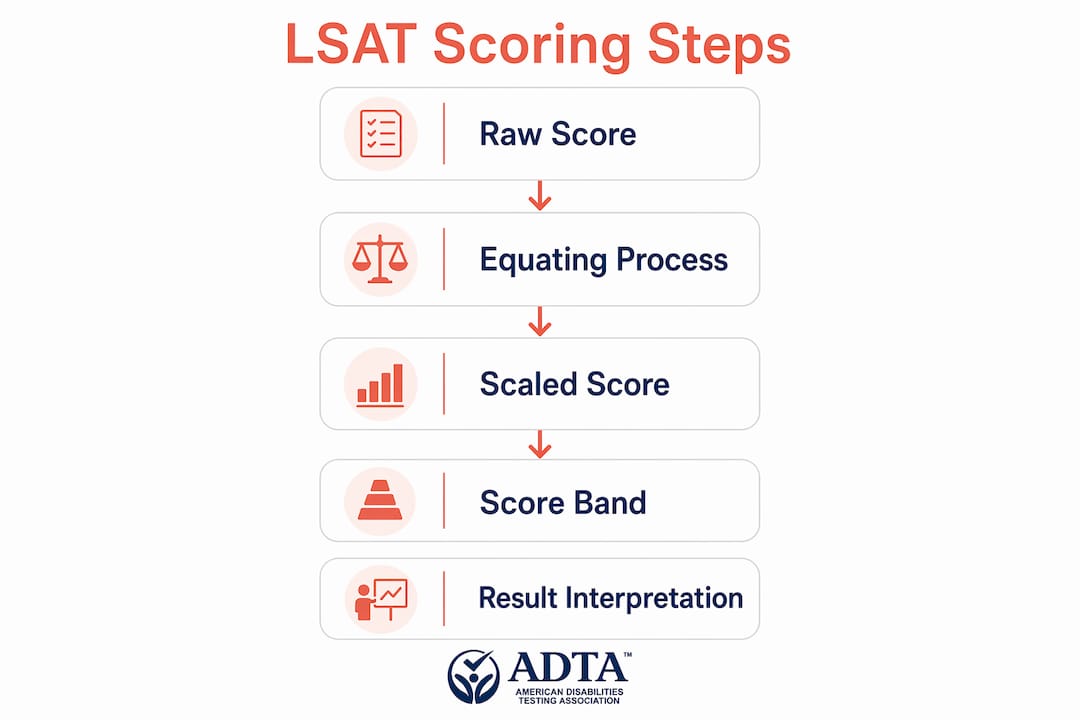
The current LSAT has approximately 75–78 scored questions across three scored sections. The conversion is not a simple percentage — LSAC uses a statistical process called equating that adjusts for differences in test difficulty from one administration to the next. A harder test form gets a slightly more generous curve.

The raw score and the equating process
Your raw score is simply the total number of correct answers from the scored sections only. There is no penalty for wrong answers, so guessing is always better than leaving a question blank.
LSAC then applies equating to produce your official scaled score. Because of this, the exact raw-to-scaled conversion changes slightly with every test.
Example: On one test form, a raw score of 57 correct might equal a 160. On a slightly harder version, the same 57 raw could convert to a 161. The difference is small but real — which is exactly why calculators give strong estimates rather than guarantees.
Why calculators give estimates, not guarantees
Practice LSAT scoring calculators use historical conversion charts to estimate your scaled score. They are accurate enough for tracking progress, but they cannot replicate the exact curve applied to any future test. Each test administration uses its own equating adjustment, so treat calculator outputs as reliable estimates rather than official predictions.
LSAC also reports scores with a score band of approximately ±3 points. A reported score of 160 reflects a true score range of 157–163. That score band accounts for natural testing variability, which means a one or two point difference between practice tests is not statistically meaningful.
Pro Tip: Use your scoring calculator after every full practice test to track trends over time, not to obsess over individual scores. A consistent upward trend across five or more tests is far more meaningful than any single result.
Sample raw-to-scaled score reference
| Raw Score (out of ~76) | Approximate Scaled Score | Approximate Percentile |
|---|---|---|
| 76 | 180 | 99.9th |
| 70 | 173 | 99th |
| 63 | 168 | 97th |
| 57 | 160 | 76th |
| 50 | 152 | 50th |
| 43 | 145 | 26th |
These figures reflect historical averages. Your actual test form may shift values by one or two points in either direction.
What sections are scored on the LSAT?
The LSAT now has four multiple-choice sections on test day, but only three are scored. Official LSAT scoring excludes the writing sample and any unscored experimental section from raw score calculations. Students must count only scored questions when using a practice calculator.
The three scored sections
-
Logical Reasoning (two sections): Makes up roughly 65–67% of your entire raw score. Each section has ~24–26 questions. Together, these two sections have the biggest impact on your final score.
-
Reading Comprehension (one section): Accounts for roughly 33–35% of your raw score, with ~26–28 questions. It tests your ability to understand dense passages and answer detail, inference, and structure questions.
Every correct answer is worth exactly the same, no matter which section it comes from.
The unscored writing sample
The writing sample is unscored and does not affect your scaled score or percentile rank. LSAC sends it to law schools, which may review it qualitatively as part of the admissions process. You can read more about its role in applications at the LSAT writing sample purpose guide from LSAT Accommodations. Do not include writing sample questions when counting your raw score in any calculator.
The experimental section
Every LSAT includes one unscored experimental section, which looks identical to a scored section. You will not know which section it is during the test. Exclude it from your raw score count. Practice calculators based on 76 questions already account for this by design.
How to use an LSAT score calculator step by step
Using a scoring calculator correctly takes less than two minutes, but the inputs must be accurate. Follow these steps every time you score a practice test.
-
Complete a full, timed practice test. Simulate real conditions. Do not pause the clock or skip sections.
-
Count only correct answers from scored sections. Add up correct answers from the two Logical Reasoning sections and the one Reading Comprehension. Do not include the writing sample or any section you have identified as experimental.
-
Enter your raw score into the calculator. Input the total number of correct answers, not your percentage or the number of questions attempted.
-
Read the scaled score output. The calculator will return a scaled score between 120 and 180 and, in most cases, an estimated percentile.
-
Interpret the percentile in context. A score of 152 places you at the national median. A score of 168 places you in approximately the 97th percentile. A score of 157 sits around the 70th percentile and is competitive for many regional law schools.
-
Log the result and compare trends. Record each practice score in a tracking sheet. Use the LSAT error log process to identify which question types are pulling your raw score down.
Pro Tip: Verify that the calculator you use is based on a recent test form. Conversion charts from tests before August 2024 may not reflect current scoring curves accurately.
Students sometimes confuse LSAT score conversion with a simple percentage calculation. It is not. A student who answers 57 out of 76 questions correctly earns roughly a 75% raw accuracy rate, but that converts to a scaled score of approximately 160, not 75 on the 120–180 scale. The conversion chart is the key, not the percentage.
Which sections to prioritize when time is limited
Because Logical Reasoning now makes up two thirds of your score, it is by far the highest-leverage section.
Smart prioritization strategy:
-
Attack Logical Reasoning first and hardest — finish both sections cleanly. One extra correct LR question has the same value as anywhere else, but there are simply more of them.
-
For Reading Comprehension: Quickly map each passage by reading the first and last sentence of every paragraph before answering questions. This saves 30–60 seconds per passage.
-
Never leave a question blank. A blind guess gives you a 20–25% chance of points; a blank gives 0%.
-
Flag time-suckers (parallel reasoning, parallel flaw, hard RC inference questions) and return to them after easier ones are done.
-
Watch your pacing by section thirds. Divide each section into thirds by question count. If you are behind pace at the one-third mark, skip the current question and move forward. Return only if time allows.
Understanding LSAT score factors like section weighting and question type difficulty helps you build a test-day strategy that reflects how the scoring actually works, not just how hard each question feels in the moment.
Key Takeaways
The LSAT scoring calculator converts raw correct answers into a scaled score from 120 to 180 using an equating process, and Logical Reasoning carries the most weight with roughly 50% of all scored questions.
| Point | Details |
|---|---|
| Scaled score range | The LSAT scores from 120 to 180, based on approximately 76 scored questions. |
| Equating adjusts the curve | Raw-to-scaled conversions vary by test form, so calculator outputs are estimates, not guarantees. |
| Three sections count | Two Logical Reasoning sections and one Reading Comprehension section affect your score. |
| No penalty for guessing | Always answer every question; a blank answer guarantees zero points. |
| Logical Reasoning drives score | With two full sections, it is the highest-leverage area for raw score gains. |
What I’ve learned from watching students misuse scoring calculators
Students treat the scoring calculator as a verdict. It is not. It is a compass.
The most common mistake I see is a student who scores a 152 on a practice test, looks up the national average, and concludes they are “right on track.” A score of 152 is the national median, but median enrolled students at ABA-accredited law schools typically score 155–158. At top-14 schools, the median is often above 170. The national average is not your target. Your target school’s median is.
The second mistake is treating a one-point drop between practice tests as a crisis. LSAC’s own score band of ±3 points means a score of 160 and a score of 158 are statistically indistinguishable. Small score differences between tests reflect normal variability, not a real change in your ability. Focus on five-test trends, not single-test results.
The third mistake is ignoring section-level data. A student who scores 157 overall but answers only 60% of Logical Reasoning questions correctly has a very different problem than one who scores 157 with 85% accuracy in Logical Reasoning and 50% in Reading Comprehension. The calculator gives you a number. Your error log gives you a plan.
Realistic goal-setting, grounded in percentile data and your target school’s actual medians, produces better outcomes than chasing a round number. A score of 168 is not inherently better than a 165 if your target school’s median is 163. Know your number, build toward it, and use the calculator as a progress tool, not a finish line.
— American Disabilities Testing Association
LSAT Accommodations can level your testing conditions
Students with anxiety disorders, ADHD, or other conditions often discover that test-day conditions, not preparation, are the real limiter on their scores.
LSAT Accommodations (provided by the American Disabilities Testing Association) helps candidates secure extra time, additional breaks, and a remote testing exception through LSAC, subject to LSAC’s approval.
We provide a 100% money-back guarantee if the request is denied.
Students who apply early get the longest runway to practice under their approved conditions. Start today by completing the accommodations intake form at LSATaccommodations.com.

The process starts with a clinical evaluation by licensed professionals who understand LSAC’s documentation requirements. No prior diagnosis is required to apply for an evaluation for an LSAT accommodation. Students who apply early give themselves the most time to prepare under the conditions they will actually test in.
FAQ
What is the LSAT score range?
The LSAT scaled score range is 120 to 180, based on the number of correct answers out of approximately 76 scored questions.
Does the LSAT writing sample affect your score?
The writing sample is unscored and does not affect your scaled score or percentile. Law schools receive it separately and may review it as part of their admissions process.
What raw score do you need for a 160 on the LSAT?
A raw score of approximately 57 correct answers out of 76 corresponds to a scaled score of around 160, placing you in roughly the 73rd–80th percentile.
Why does the same raw score produce different scaled scores on different tests?
LSAC uses an equating process to adjust for test difficulty across administrations. A raw score may convert to a scaled score varying by ±1–2 points depending on the difficulty of that specific test form.
Is there a penalty for wrong answers on the LSAT?
No. The LSAT does not deduct points for incorrect answers. Students should always guess on questions they cannot confidently answer rather than leaving them blank.