
8 LSAT Reading Comprehension Tips and Examples That Raise Scores

If you only change eight things about how you take Reading Comprehension, make them these: map each paragraph with a five-word tag as you read, predict the answer before you look at the choices, triage passages in the first 30 seconds, mark only the conclusion and the author’s attitude, underline signal words like “however” and “therefore,” run blind review on every practice section, favor the flattest and most literal answer choice when torn between two, and drill with official LawHub tests instead of third-party imitations. Each one targets a specific failure point: paragraph tags fix “I can’t find where this was mentioned,” prediction fixes “I fell for the trap answer,” and triage fixes “I ran out of time on my best passage.” Below, each tactic gets a real example you can copy the next time you sit down with a practice section.
Pro Tip: Try tagging just one paragraph today with a phrase like “critic’s objection to theory” instead of a full sentence. Shorter tags force you to identify the paragraph’s function, not just its topic, which is what actually helps you locate evidence later.
Key Takeaways
Reading Comprehension improvement comes from pairing a repeatable mapping and prediction method with disciplined blind review, not from reading faster or memorizing vocabulary lists.
| Point | Details |
|---|---|
| Tag every paragraph | Write a five to twelve word function tag per paragraph to speed up evidence location later. |
| Mark sparingly | Underline only the conclusion, attitude words, and transition signals, never full sentences. |
| Predict before choices | Paraphrase the stem and predict an answer before reading the options to dodge distractors. |
| Triage passages fast | Scan openings and question types in the first fifteen seconds to pick your strongest passage first. |
| Run blind review | Re-answer missed questions without your original choice visible, using an error journal to track patterns. |
| Consider accommodations if anxiety limits performance | LSAT Accommodations by ADTA prepares LSAC-ready documentation for extended time and related accommodations, with a money-back guarantee. |
Table of Contents
- 1. Lsat Reading Comprehension Tips and Examples for Passage Mapping
- 2. Annotation and Highlighting Strategies That Actually Save Time
- 3. Question Approach and Worked Examples for Common Question Types
- 4. Time Management: Triage, Passage Order, and Flagging
- 5. Practice Routines, Blind Review, and a Sample 4-Week Plan
- 6. What LSAC’s Official Guidance Says About Reading Comprehension
- 7. Building Vocabulary and Comprehension for Dense Passages
- A Personal Note on What Changed the Score
- How Accommodations Can Complement Your Reading Comprehension Strategy
- Sources
1. Lsat Reading Comprehension Tips and Examples for Passage Mapping
Passage mapping means writing a short label next to each paragraph that captures its job in the argument, not its subject matter. Number the paragraphs one through four or five as you read, then jot a five to twelve word tag on your scratch paper (digital test takers get an on-screen scratch sheet, so this works identically there). A tag isn’t “paragraph about economics.” It’s “author rejects mainstream economic model” or “counterargument, then author’s rebuttal.”
Take a mock passage about a historian challenging a popular theory of early trade routes. Your tags might look like this:
- P1: Standard theory of trade route origin
- P2: Archaeological evidence that complicates it
- P3: Author’s revised timeline
- P4: Why revised timeline matters for other fields
When a question asks what the author would most likely say about a claim in paragraph 2, you skip the reread. You know P2 holds the complicating evidence and P3 holds the author’s actual position, so you check both and answer in under thirty seconds instead of ninety.
On the digital interface, switch to Passage Only view while you build your map, then flip to Passage and Question view once you start answering. This keeps your eyes on the text during the read, then gives you full real estate for eliminating choices without scrolling. Blueprint Prep’s digital LSAT guidance recommends this exact split, and it also cuts down on the temptation to highlight everything because you’re not staring at answer choices while you read.
Skim dense, technical paragraphs (a scientific process, a legal doctrine’s history) for structure only. Slow down on paragraphs where the author’s voice enters directly, phrases like “this view is mistaken” or “a more compelling explanation exists.” That’s usually where questions cluster.
Pro Tip: If a paragraph is pure background or setup, your tag can be one word: “context.” Don’t force detail into a paragraph that doesn’t have any.
2. Annotation and Highlighting Strategies That Actually Save Time
Mark three things and nothing else: the main claim or conclusion, words that reveal the author’s attitude (“surprisingly,” “unfortunately,” “convincingly”), and signal phrases that show argument structure (“however,” “therefore,” “for example,” “by contrast”). Everything else is noise that costs you seconds you don’t have.

What wastes time is highlighting full sentences or copying phrases onto scratch paper as if you’re taking notes for a class. It’s the annotation equivalent of a search function with too many results. Treating annotation like a manual “find” tool, hunting for a marked phrase instead of relying on your paragraph tags, is one of the more common time sinks tutors flag in RC review sessions, per Blueprint Prep’s breakdown of digital-test tactics.
Here’s what minimal marking looks like on a single paragraph:
You underline “however” because it flags a pivot. You bracket the bolded clause because it’s the paragraph’s actual claim. You leave “Critics argue the policy failed” unmarked because it’s the setup, not the payoff. Two marks. Ten seconds. That’s the whole annotation for that paragraph.
- Mark the conclusion, not the evidence leading to it.
- Mark attitude words, not descriptive ones.
- Mark transition words that signal a structural shift.
- Skip anything you could reconstruct from memory in five seconds.
3. Question Approach and Worked Examples for Common Question Types
Before you look at any answer choice, restate the question stem in your own words and predict what the answer should say. A stem asking “which of the following, if true, would most weaken the author’s argument in the third paragraph” is not the same task as “the passage most strongly supports which of the following.” The first asks you to imagine new information; the second restricts you to what’s already stated.
That distinction matters for elimination logic. “Must be true” and inference stems require an answer directly supported by the text. Weaken, strengthen, and application stems ask you to reason one step beyond it. Thinking LSAT’s reading comprehension breakdown makes the case that even most inference and application questions still reward the answer most tightly anchored to what the passage actually says, rather than the most clever or extreme option.
Quick worked examples:
- Main point: Predict a one-sentence summary before scanning choices. If your summary mentions the author’s specific critique, eliminate any choice that’s purely descriptive or too broad.
- Detail: Locate the exact line using your paragraph tags, then match wording closely. Detail questions rarely reward paraphrase drift.
- Inference: Ask “what has to be true if this passage is accurate?” Reject anything requiring an assumption the author never makes.
- Application: Find the principle in the passage, then look for a choice that mirrors its logical structure in a new scenario.
- Author attitude: Reread your underlined attitude words. The correct choice usually matches the intensity of that word, not just its direction.
- Comparative (paired passages): Predict where the two authors agree and where they diverge before touching the choices.
When two choices seem plausible, pick the more conservative, boring one. Testmakers reward neutral restatements of the text over anything that sounds insightful or dramatic, because insight is easy to overstate and hard to defend against a skeptical reread.
4. Time Management: Triage, Passage Order, and Flagging
Spend the first fifteen seconds of each passage scanning the opening lines and glancing at the question stems below it. Passages with dense, unfamiliar vocabulary in the first paragraph or five to six questions with long, layered stems usually take longer. Passages with a clear, declarative opening sentence tend to move faster.
- Do your strongest passage type first to bank early points and settle your nerves.
- Budget roughly eight to nine minutes per passage on a section with four passages and about thirty-five minutes total.
- Flag and guess rather than stall. A guessed answer at minute nine beats three unanswered questions at minute twelve.
- Save main point and global structure questions for last within a passage; they’re often easier once you’ve already answered the detail questions, since those force you back into the text anyway.
- If a passage’s first paragraph feels impenetrable, skip to the next one and return only if time allows.
A sample plan for one RC section: minutes 0 to 9 on your best passage, 9 to 18 on the next easiest, 18 to 27 on the third, and whatever remains on the fourth, flagging aggressively rather than rereading a hard paragraph a third time.
Pro Tip: If you’re already scoring in the high range, try the paired passage last. Comparative sets take longer to map but often have more predictable, text-anchored questions once you’ve built both maps.
5. Practice Routines, Blind Review, and a Sample 4-Week Plan
Real improvement comes from a loop: timed section, immediate blind review, targeted drill on your weak question type, then spaced repetition of that drill a few days later — see these effective LLQP Exam Prep Tips & Study Guides for additional strategies. Blind review means re-answering every question you got wrong (and any you guessed on) without looking at your original choice, until you can explain why the correct answer is right using only the passage text.
Log four things per missed question: the question type, why you got it wrong (misread the stem, missed a detail, fell for a distractor), what correct reasoning actually looks like, and how long you spent. Patterns show up fast.
- Week 1: One timed passage a day plus blind review; build your error journal.
- Week 2: Add 15-minute paragraph-tagging drills on old passages you’ve already reviewed.
- Week 3: Full timed RC sections twice a week using official LawHub PrepTests, plus continued blind review.
- Week 4: Simulate full test days, review only your error journal’s recurring categories.
- Use official LawHub tests as your primary material; they’re the only source that matches actual passage difficulty and question phrasing.
- Revisit old error-journal entries weekly instead of only logging new ones.
6. What LSAC’s Official Guidance Says About Reading Comprehension
LSAC doesn’t prescribe one correct method. Its own suggested approach to Reading Comprehension states plainly that close reading, reading the questions first, or skimming and then rereading can all work, as long as you reliably identify the main idea, the passage’s structure, and the author’s attitude.
LSAC frames Reading Comprehension as a test of whether you can read complex material the way a law student has to: pulling out the argument’s structure and the author’s stance, not memorizing details for their own sake.
What changed and what didn’t: starting in August 2024, the LSAT moved to two scored Logical Reasoning sections and one scored Reading Comprehension section, plus one unscored experimental section that could be either. RC still gets exactly one scored shot, so passage triage and timing matter more, not less, than before.
- Use LSAC’s own sample Reading Comprehension questions before turning to third-party material.
- Prioritize LawHub PrepTests for full-length practice; they’re the only source built from retired official exams.
7. Building Vocabulary and Comprehension for Dense Passages
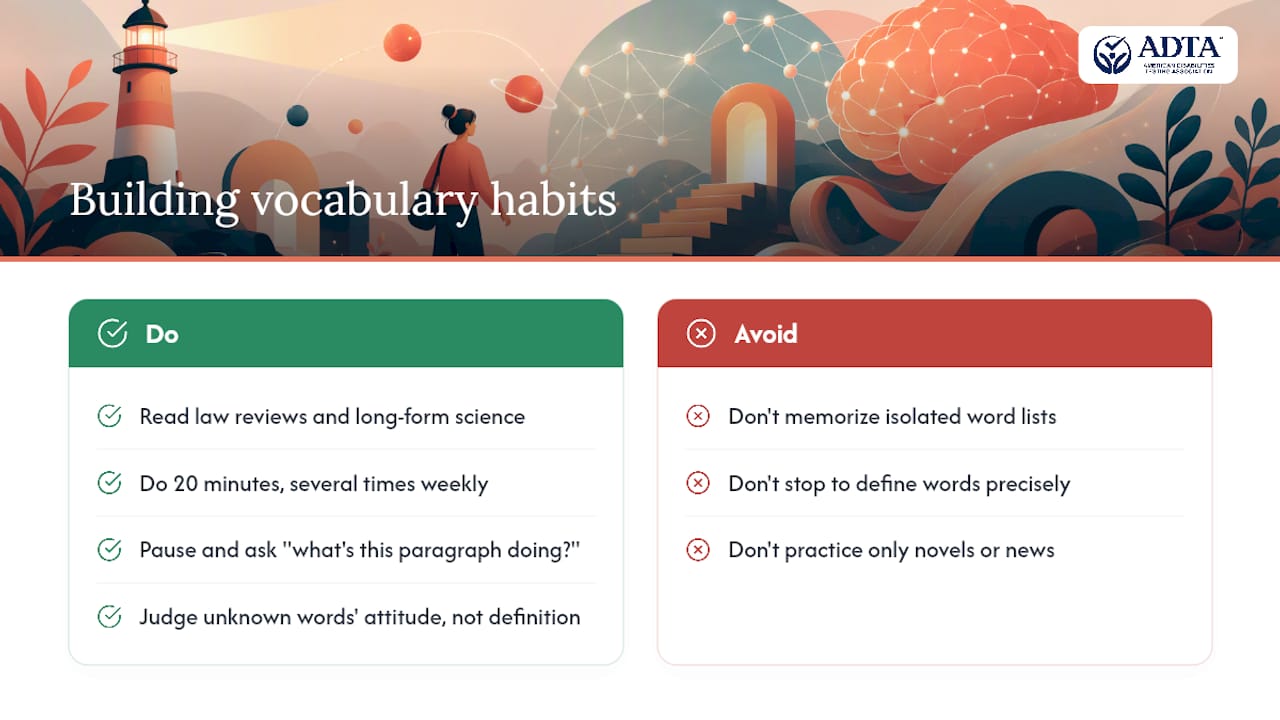
RC passages pull from law, science, history, and the humanities, often with vocabulary that’s precise rather than obscure: “conflate,” “underdetermined,” “normative,” “empirical.” You don’t need a memorized word list. You need repeated exposure to how these words function inside an argument, since LSAT vocabulary questions are really structure questions wearing a vocabulary costume.
Read outside your comfort zone deliberately. Law review abstracts, long-form science journalism, and academic book reviews all mimic RC’s register better than novels or news articles do. Twenty minutes a few times a week of that kind of reading, paired with the habit of pausing to ask “what is this paragraph doing, not just saying,” builds the same muscle passage mapping does.
When you hit an unfamiliar word inside a passage, don’t stop to define it precisely. Ask instead whether the surrounding sentence tells you if it’s positive, negative, or neutral in context. LSAT questions almost never require a dictionary-level definition. They require you to track whether a word signals agreement, doubt, or contrast, which is exactly the skill you’re already training with attitude-word annotation.
Comparative and paired passages reward this even more, since you’re tracking two authors’ vocabulary choices against each other. If one author calls a theory “elegant” and the other calls it “convenient,” that word gap is often the entire basis for a comparative question.
A Personal Note on What Changed the Score
Once test takers commit to tagging every paragraph and running honest blind review, their timing complaints tend to fade first, before accuracy even catches up. One repeatable change worth trying tonight: review your next three wrong answers without your original choice in view, and write down the exact line that proves the right one.
How Accommodations Can Complement Your Reading Comprehension Strategy
Every tactic in this article assumes you have enough time and a low enough anxiety load to actually apply it. For test takers whose anxiety disorder or other documented condition disrupts that baseline, no amount of paragraph tagging fixes a nervous system in fight-or-flight mode at minute twenty. That’s a documentation problem, not a strategy problem.

Accommodations such as extended time, additional breaks, removal of the experimental section, a paper-and-pencil format, or remote testing don’t replace the work in this article. They change the conditions under which that work gets applied, giving you room to actually use triage, blind review habits, and paragraph mapping instead of racing the clock in a heightened anxiety state. LSAT Accommodations by ADTA prepares the clinical evaluation and LSAC-ready documentation packet directly, without requiring a prior diagnosis, and backs the process with a full money-back guarantee if a request is denied. If your practice scores swing wildly between timed and untimed conditions, that gap itself is often a signal worth evaluating. Start the LSAT accommodations intake process to see whether your situation qualifies, or review how the documentation process works before you begin.
Sources
- Suggested Approach for Reading Comprehension — LSAC
- How to approach the reading comprehension section on the digital LSAT — Blueprint Prep
- Reading Comprehension — Thinking LSAT