
Clinicians: Build LSAT Accommodation Packets That Meet LSAC Standards

An LSAT accommodation packet is the full set of forms and clinical evidence you submit to LSAC to request testing changes for anxiety, and it must go through JD Services by your test’s registration deadline with no exceptions. Your three immediate moves: confirm your registration deadline, pull together or update clinician documentation from within the last five years, and start drafting your statement of need now, not the week before.
TL;DR:
- Most denials occur because of vague documentation that lacks specific links between anxiety symptoms and testing limitations, not because the condition isn’t real.
- To support extended time requests, clinicians must include objective measures or detailed behavioral reports showing how anxiety impacts timed performance.
- Submitting outdated evaluations or inconsistent records from the past five years often triggers delays or denials, especially if discrepancies with prior accommodations exist.
- Most rejection issues come from technical errors like illegible files, wrong formats, or foreign-language documents without proper translation.
- Working with a clinician knowledgeable about LSAC standards and documentation categories can significantly improve the chances of approval and streamline the process.
Table of Contents
- What Belongs in an LSAT Accommodation Packet?
- How Should a Clinician Document Anxiety for LSAC?
- How Do You Prepare the Candidate Statement and Submit Through JD Services?
- When Should You Submit, and What Happens During Review?
- Why Do LSAT Accommodation Requests Get Denied?
- How LSAT Accommodations by ADTA Approaches Anxiety Documentation
- The Real Bottleneck Isn’t Anxiety, It’s the Paperwork
- Start Here: Getting Your Accommodation Packet Built Right
- Sources
- FAQ
What Belongs in an LSAT Accommodation Packet?
Your packet has two halves: what you write, and what your clinician writes. LSAC expects both, and reviewers can tell within a paragraph whether either one was rushed.
The candidate side includes the Statement of Need, where you personally describe how anxiety affects your test performance and why a specific accommodation would fix that. The clinician side includes the Qualified Professional Form, a signed letter on official letterhead, or a full psychological assessment, any of which must confirm diagnosis, severity, and the exact rationale for what you’re asking for. If you have prior IEP or 504 records from high school or college testing, include them. They give LSAC a documented pattern rather than a fresh, unsupported claim.
Everything you submit maps to one of three documentation categories:
- Category 1 covers non-extended time requests, such as a separate testing room or minor scheduling adjustments.
- Category 2 covers up to 50% extended time (100% for severe visual impairments) plus non-time requests like a reader or scribe.
- Category 3 covers exceptional needs: more than 50% extra time, paper-and-pencil administration, stop-and-start breaks exceeding 60 minutes, or testing spread across multiple days.
If you’ve received formal accommodations before, on the LSAT, SAT, ACT, or in school, LSAC’s prior accommodations policy can lighten the documentation burden somewhat, but only if that history is consistent with what you’re now requesting. Ask for more than your history supports, and you’ve created a gap the reviewer has to question.
How Should a Clinician Document Anxiety for LSAC?
The Qualified Professional statement carries more weight than most candidates realize. A vague letter that says “this person has anxiety and needs extra time” gets denied constantly, because it never explains the mechanism connecting diagnosis to testing limitation.
A strong clinician statement includes:
- Diagnosis and exam details. The specific diagnosis, when the evaluation occurred, and whether the clinician personally examined the candidate or relied on records alone.
- Objective measures where available. Standardized assessment scores, timing data from prior tests, or documented behavioral observations under time pressure. LSAC’s own guidance on insufficient documentation notes that narrative description alone rarely carries a request for more time than previously granted.
- Severity and functional impact. How anxiety symptoms specifically disrupt timed, high-stakes performance, not general daily functioning.
- Explicit rationale tying symptom to accommodation. If panic attacks spike under a countdown clock, that connects logically to extended time or additional breaks. If concentration collapses after 35 minutes, that supports a stop-the-clock break structure.
Documentation should generally fall within five years for psychological and mental health conditions. Older evaluations can still work if the clinician explicitly addresses why the condition remains stable or has worsened, but that requires an added paragraph most letters skip.
Pro Tip: Ask your clinician to write one sentence per accommodation that starts with “Because of X symptom, Y accommodation is necessary.” Reviewers read hundreds of these packets, and that direct sentence structure is exactly what they’re scanning for.
How Do You Prepare the Candidate Statement and Submit Through JD Services?
Your own statement needs specifics, not adjectives. Describe an actual test-day scenario: the moment your mind went blank on a timed section, the physical symptoms that hit at the 20-minute mark, the practice test where you lost ten minutes to a panic spiral. Attach anything that backs up the story, old test accommodations letters, therapy records, prior LSAT or SAT scores under standard time versus extended time.
Before you upload anything, check the technical requirements:
- Accepted file formats include JPG, GIF, PNG, PDF, DOC, DOCX, RTF, HTM, HTML, and TXT.
- Non-English documents need an official translation attached.
- Keep every original file. LSAC does not return submitted documentation once it’s uploaded.
- Never upload the same document under two different names. It creates confusion during review rather than redundancy.
Inside your LSAC account, the request lives under “Request or Modify Accommodations” in JD Services. You can save progress and return later, which matters because this form takes longer to do well than most candidates expect.
When Should You Submit, and What Happens During Review?
The accommodation request deadline is the same as your test registration deadline for that specific LSAT administration, and LSAC enforces it with no exceptions. Submitting the day before doesn’t leave room for a clarifying document request, so build in real buffer.
Once submitted, status updates post inside JD Services rather than through a phone call or a generic email. Review timing varies by volume and by how complete your packet is; incomplete or internally inconsistent documentation is one of the most common causes of delay.
If you run into a technical snag or need to check on your file:
- Email Lsac for accommodation-specific questions.
- Call the Accommodated Testing phone line listed on LSAC’s site for time-sensitive issues.
- Use accommodationcomplaints@LSAC.org if you’re pursuing an appeal after a denial.
Appeals have their own deadlines that run separately from your original submission window, so don’t assume a denial gives you unlimited time to respond. Move on it immediately.
Why Do LSAT Accommodation Requests Get Denied?
Most denials trace back to one of four fixable problems, and almost none of them are about whether your anxiety is real.
- Vague documentation with no functional link. A letter that names a diagnosis but never explains how it disrupts timed testing reads as incomplete. Fix it by having your clinician write specific, symptom-to-accommodation sentences.
- Outdated or inconsistent records. A five-year-old evaluation, or a statement that contradicts your academic accommodation history, raises immediate questions. Fix it with a current evaluation that acknowledges and reconciles any prior history.
- Requesting more time than your history supports. Asking for 100% extended time when you’ve only ever received 50% needs objective justification, not just a request. LSAC’s guidance is explicit that stronger evidence is required here.
- Technical errors. Illegible scans, wrong file types, or untranslated foreign-language records get flagged before anyone even evaluates the clinical content.
LSAC has stated that its review process is individualized, and documentation that’s incomplete or inconsistent with a candidate’s academic history routinely delays or derails a request. That single fact explains most of the denials candidates never see coming.
How LSAT Accommodations by ADTA Approaches Anxiety Documentation
This service prepares documentation built around the standards outlined above: licensed clinician evaluations, a properly completed Qualified Professional Form, and a statement of need that ties anxiety symptoms to a specific accommodation. It offers remote evaluation options and an expedited delivery path.
What this looks like in practice:
- A licensed clinician conducts the evaluation and writes the objective rationale LSAC’s reviewers are trained to look for.
- Forms arrive already aligned with current documentation and five-year currency standards.
- Candidates without a prior diagnosis still go through a full clinical evaluation rather than being turned away.
Clinician credentials and process details are outlined on the how it works page for candidates who want to see the specifics before starting.
The Real Bottleneck Isn’t Anxiety, It’s the Paperwork
Most advice about LSAT accommodations focuses on convincing candidates their anxiety is legitimate enough to deserve support. LSAC focuses on whether documentation proves a specific, testable link between symptoms and the requested accommodation, and many candidates get denied because their paperwork is generic.

The conventional advice, “get a letter from your doctor,” undersells how much the letter’s structure matters. A general practitioner who’s never seen a standardized testing accommodation form will often write something clinically accurate but functionally useless to LSAC. The professionals who get this right are the ones who’ve written these statements before and know exactly which sentence a reviewer is scanning for.
If there’s one thing to prioritize first, it’s this: don’t start with the forms. Start with a clinician who already understands LSAC’s documentation categories. Everything else, the statement of need, the file uploads, the timeline, gets dramatically easier once that piece is right.
— American Disabilities Testing Association
Start Here: Getting Your Accommodation Packet Built Right
If you’ve read this far wondering whether your documentation is strong enough, that uncertainty is a problem some services exist to remove. Working directly with a licensed clinician who evaluates you against LSAC standards can help, whether or not you’ve had a prior diagnosis.

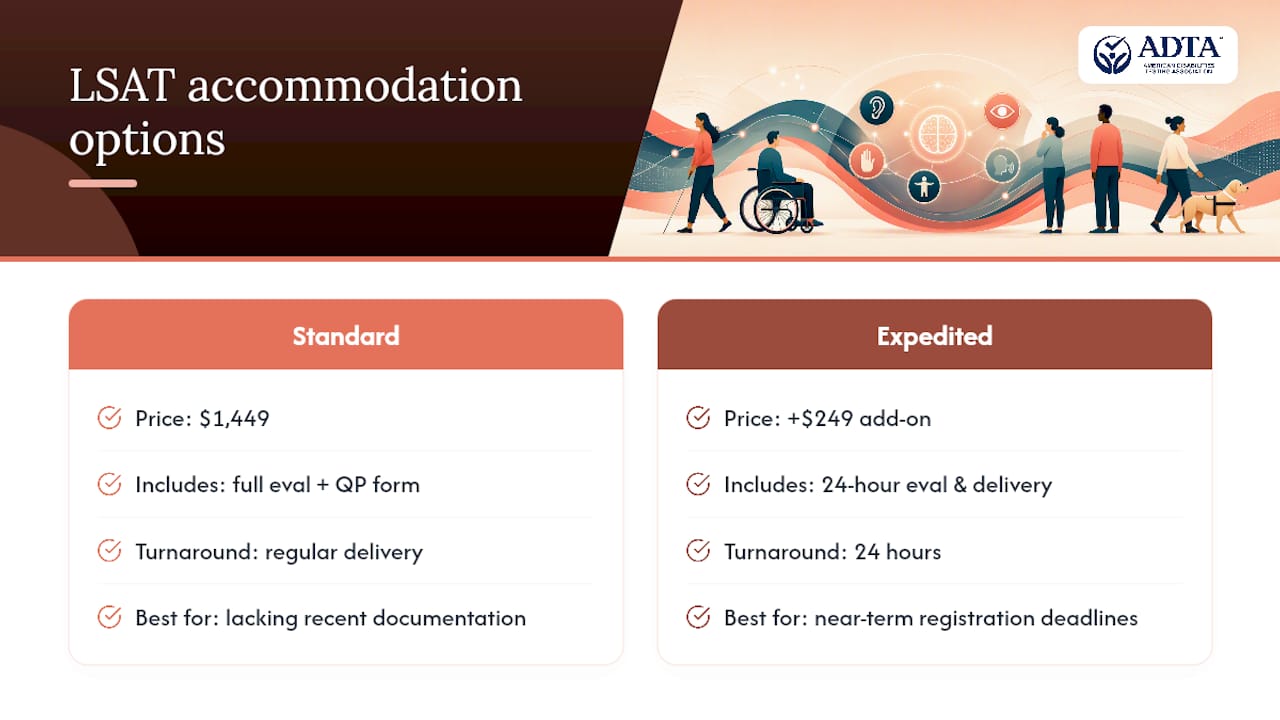
The LSAT Accommodation Evaluation and Documentation service runs $1,449 as a one-time fee and includes a full clinical evaluation plus preparation of your Qualified Professional Form and statement of need. Candidates working against a near-term registration deadline can add 24-hour expedited evaluation and delivery for $249.
Before you start the intake form, have your ID, any prior accommodation records, and past evaluations ready to upload. If you’re also researching what medical items you’re permitted to bring into the test center, SupportPet’s guide on emotional support documentation covers related rights questions worth understanding separately. This service fits best if you lack recent clinical documentation or simply want an evaluation written by someone who already knows LSAC’s forms inside out.
This article is general information, not a substitute for advice from a qualified doctor. Consult a qualified healthcare professional about your own circumstances before acting on anything here.
Sources
FAQ
What is an LSAT accommodation packet?
It’s the complete set of forms and clinical evidence, including the Qualified Professional Form and your statement of need, that you submit through JD Services to request testing changes. It must be submitted by your test’s registration deadline.
How old can anxiety documentation be for LSAT accommodations?
Mental and cognitive documentation generally needs to fall within five years. Older evaluations can still work if the clinician explains why the condition remains stable or has changed since.
What’s the difference between Category 2 and Category 3 accommodations?
Category 2 covers up to 50% extended time plus non-time requests like a reader.
Why do LSAT accommodation requests for anxiety get denied?
The most common reasons are vague documentation without a clear functional link, outdated evaluations, and requesting more time than prior history supports without objective evidence. Technical errors like illegible scans also cause avoidable denials.
How much does LSAT Accommodations by ADTA charge for documentation help?
The evaluation and documentation service costs $1,449 as a one-time fee, with an optional $249 add-on for 24-hour expedited delivery.