
LSAC Required Paperwork for Disability Accommodations

LSAC disability accommodations are defined as formal testing modifications granted to candidates whose documented disabilities create functional barriers to standard exam conditions. Obtaining them requires submitting specific LSAC required paperwork for disability accommodations: a Candidate Form, a Qualified Professional Form, and a detailed clinician’s letter, all completed by a licensed clinician who knows LSAC’s formatting standards. Anxiety disorders qualify when supported by objective evidence of functional limitations in timed testing. Getting this paperwork right the first time is the single most reliable way to protect your test date and your law school timeline.
What specific paperwork does LSAC require for disability accommodation requests?
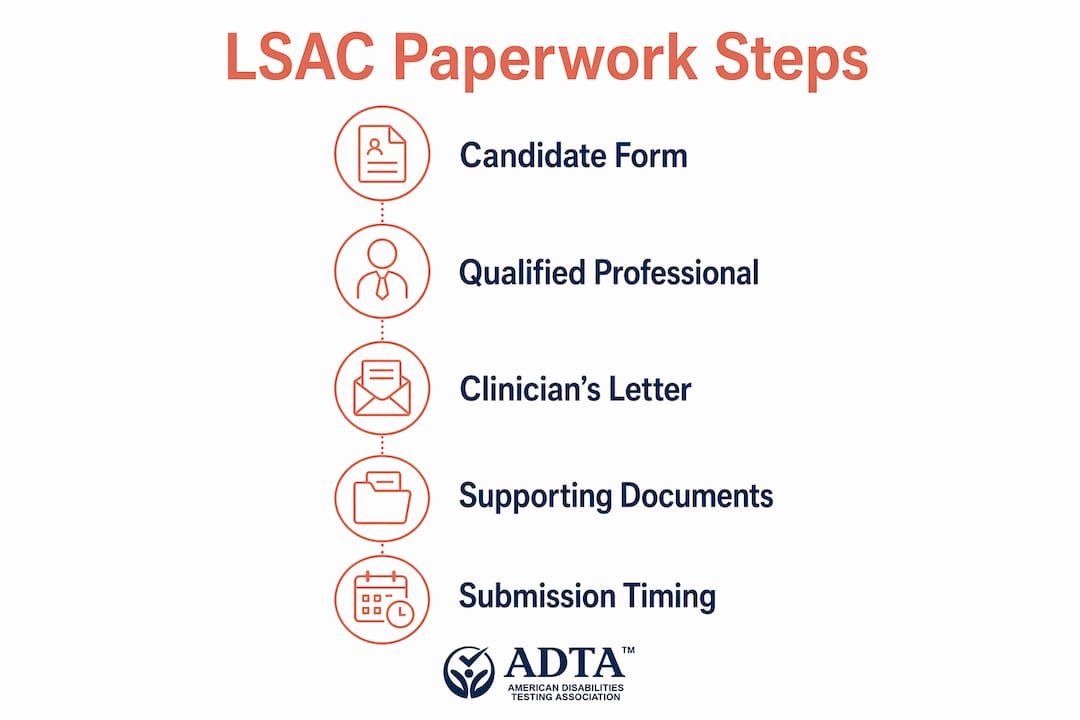
LSAC requires three core documents to process any accommodation request. Each document has a defined role, and a missing or vague component is enough to trigger a denial.
The Candidate Form
The Candidate Form is your formal request. You complete and certify it, confirming your disability and the accommodations you are requesting. This form is not a medical document. It is your signed statement that the information you are submitting is accurate and complete. Some companies will work with you to help you fill this form out to make the process easier for you.

The Qualified Professional Form
The Qualified Professional Form is completed by your clinician, not by you. It requires the clinician to document your diagnosis, describe how the condition was established, and explain how it affects your ability to perform under timed testing conditions. LSAC evaluates requests by prioritizing objective data, such as cognitive test scores, over general symptom descriptions. A clinician who simply writes “patient experiences anxiety” will not satisfy this standard.
The clinician’s letter
The clinician’s letter supplements the Qualified Professional Form with a narrative explanation. It must connect your diagnosis directly to the specific accommodations you are requesting. Vague notes that describe symptoms without linking them to functional limitations in timed testing are routinely rejected. The letter should state the diagnosis, explain how it was established, describe its measurable impact on test performance, and recommend specific accommodations such as extended time, additional breaks, or a reduced-distraction environment.
Supporting Documents
Even though documents from prior medical evaluations and prior accommodation documentation are not required, any information about the history of your condition may help the clinician better understand your symptom history and how it has affected you in testing situations.
All documentation must be recent. Clinical evaluations must generally be from within the last five years to meet LSAC standards. Older records may be used as supporting history but cannot substitute for a current evaluation.
How your clinician processes your LSAC paperwork
Choosing the right clinician is the most consequential decision in this process. Your clinician must be a licensed professional, such as a psychologist, psychiatrist, or licensed clinical social worker, who is familiar with LSAC’s specific forms and formatting requirements. A clinician who has never completed LSAC paperwork before, in some cases, may produce documentation that is technically accurate but structurally wrong for LSAC’s review process.
Here is a practical sequence for working with your clinician:
-
Schedule a clinical evaluation early. Expert guidance recommends reaching out to a clinician as early as possible before your test registration date (which is the same date by which you must submit your LSAT Documentation Packet to LSAC). Evaluations take time to schedule, complete, and write up.
-
Bring any accommodation history (not required). Gather any IEPs, 504 plans, college accommodation letters, or prior psychological evaluations before your first appointment. Your clinician can use this history to help evaluate your case.
-
Discuss timed testing specifically. Your clinician must understand that LSAC is not asking whether you have anxiety. LSAC is asking whether your anxiety creates a measurable functional limitation under timed exam conditions. Make sure your clinician addresses this directly in both the Qualified Professional Form and the letter.
-
Review the Qualified Professional Form together. Walk through each section with your clinician before they submit it. Confirm that every field is complete and that the language ties your diagnosis to the specific accommodations requested.
-
Request a personalized letter. Ask your clinician to write a letter that goes beyond the form. The letter should include the diagnostic method used, the functional impact on timed performance, and a clear recommendation for each accommodation requested.
-
Check formatting before submission. LSAC requires all documents to be submitted as PDFs. Confirm that your clinician’s letter is on official letterhead, signed, and dated.
Pro Tip: Ask your clinician directly: “Have you completed LSAC accommodation paperwork before?” If the answer is no, provide them with LSAC’s documentation requirements page and the best practices guide before your appointment.
Anxiety disorders are recognized conditions for LSAC testing accommodations when supported by evidence of functional limitations affecting timed exams. The key word is “functional.” Your clinician must describe what anxiety prevents you from doing under time pressure, not just that you experience anxiety.
Submission process and timing: how to file your accommodation request properly
LSAC processes all accommodation requests through a single portal. You must have an active LSAT registration before you can submit. Once registered, log into your JD Account and navigate to “Request or Modify Accommodations.” All documents must be uploaded as PDFs through this portal. LSAC does not accept emailed or mailed submissions.
Key facts about the submission process:
-
Active registration is required first. You cannot submit accommodation paperwork without first registering for a specific LSAT date.
-
Deadlines are firm. Paperwork must be submitted by the LSAT registration deadline for your chosen test date. Missing this deadline means waiting for the next available test cycle.
-
All documents upload as PDFs. Clinician letters must be on official letterhead. Scanned handwritten notes are not acceptable.
-
LSAC reviews after submission. Once submitted, LSAC’s team reviews your request. This review takes time, and you will not receive an instant decision.
-
Common rejection triggers include: incomplete forms, outdated evaluations, vague clinician letters that do not connect diagnosis to functional limitations, and missing supporting history documents.
Thoroughness and accuracy in paperwork preparation are the primary factors separating approved requests from rejected ones. A single missing field on the Qualified Professional Form can delay your entire test cycle.
Pro Tip: Submit your paperwork at least two to three weeks before the deadline. This gives you time to respond if LSAC requests additional information before the cutoff.
What happens if your LSAC accommodation paperwork is incomplete or rejected?
A denial does not end your options, but it does cost you time. Understanding why requests fail helps you avoid the most common mistakes.
Typical reasons for denial include:
-
Insufficient documentation: The clinician’s evaluation does not include objective data such as cognitive test scores or standardized assessment results.
-
Vague functional descriptions: The letter describes symptoms but does not explain how those symptoms impair timed test performance specifically.
-
Outdated records: The clinical evaluation is older than five years and no current evaluation is included.
-
Formatting errors: Documents are not in PDF format, are missing signatures, or are not on official letterhead.
Clinicians’ detailed, objective reports significantly increase success probability when they focus on precise functional impairments rather than vague symptoms.
If LSAC denies your request, you can request reconsideration and submit supplemental documentation. This process takes additional time, which is why starting early matters so much. A denial that arrives two weeks before your test date leaves almost no room to respond. The law school application disability documentation process rewards candidates who treat paperwork preparation as seriously as they treat LSAT prep itself.
Key Takeaways
LSAC accommodation requests have a larger chance of succeeding when all three required documents are complete, current, and written by a clinician who connects your diagnosis directly to functional limitations in timed testing.
| Point | Details |
|---|---|
| Three documents are required | Submit the Candidate Form, Qualified Professional Form, and a clinician’s letter for every request. |
| Clinician selection matters | Choose a licensed professional who has completed LSAC forms before and understands timed-testing functional impact. |
| Documentation must be recent | Clinical evaluations must generally be from within the last five years to meet LSAC standards. |
| Prior accommodation history strengthens requests (not required) | IEPs, 504 plans, and college disability letters help your clinician document your condition |
| Start as early as possible | Beginning documentation collection early protects your test date if LSAC requests additional information. |
What I’ve learned from working through LSAC accommodation paperwork
The biggest mistake I see is treating LSAC accommodation paperwork as an afterthought. Candidates spend months preparing for the LSAT itself and then scramble to gather documentation in the final week before the deadline. That approach almost always produces incomplete or poorly written paperwork.
The second mistake is assuming any licensed clinician can complete LSAC forms correctly. LSAC’s Qualified Professional Form has specific fields that require specific language. A clinician who is unfamiliar with those requirements will fill in the fields accurately from a clinical standpoint but miss the functional-limitation framing that LSAC’s reviewers are looking for. The result is a denial that feels unfair but is entirely predictable.
Accommodations are not a shortcut. They are a legal recognition that standard testing conditions do not measure your ability fairly when a documented disability creates a functional barrier. Candidates sometimes hesitate to apply because they worry about how accommodations will look on a law school application. That concern is misplaced. Law schools do not see your accommodation status. LSAC keeps that information separate from the score report.
My honest advice: start the process earlier than you think you need to and find a clinician who has done this before. Give your clinician as much information during the intake process as possible to help them process your evaluation.
— American Disabilities Testing Association
How LSAT Accommodations can help with your paperwork
Getting LSAC accommodation paperwork right requires clinical expertise and familiarity with LSAC’s specific formatting standards. LSAT Accommodations, provided by the American Disabilities Testing Association, connects you with licensed clinicians who specialize in exactly this process.

LSAT Accommodations handles the full documentation process: clinical evaluation, pre-filling of the Candidate Form, completion of the Qualified Professional Form, and preparation of a clinician’s letter written to LSAC’s standards. The service offers a 100% money-back guarantee if your request is denied by LSAC. All requests are subject to final approval or denial by LSAC. You do not need a prior diagnosis to begin. Start by completing the intake form to connect with a clinician who knows LSAC’s requirements and can prepare your documentation correctly the first time.
FAQ
What forms does LSAC require for disability accommodations?
LSAC requires the Candidate Form, the Qualified Professional Form completed by a licensed clinician, and a clinician’s letter linking your diagnosis to functional limitations in timed testing. All documents must be submitted as PDFs through your JD Account portal.
How recent does my clinical evaluation need to be for LSAC?
Clinical evaluations must generally be from within the last five years to meet LSAC documentation standards. Older records can support your request as historical evidence but cannot replace a current evaluation.
Can anxiety qualify for LSAC testing accommodations?
Anxiety disorders qualify for LSAC accommodations when supported by objective evidence showing functional limitations in timed exam conditions. Common approved accommodations include extended time and additional breaks tailored to anxiety-related impairment. Some candidates may qualify for paper/pencil testing accommodations or a remote testing exception.
What happens if LSAC denies my accommodation request?
You can request reconsideration and submit supplemental documentation to address the specific reason for denial. Starting the process early gives you time to respond before your test date is affected.
Does prior accommodation history help my LSAC request?
Prior accommodations such as IEPs, 504 plans, or college disability office letters are not required but are helpful for the clinician to better understand your medical history when processing your evaluation. Recommended